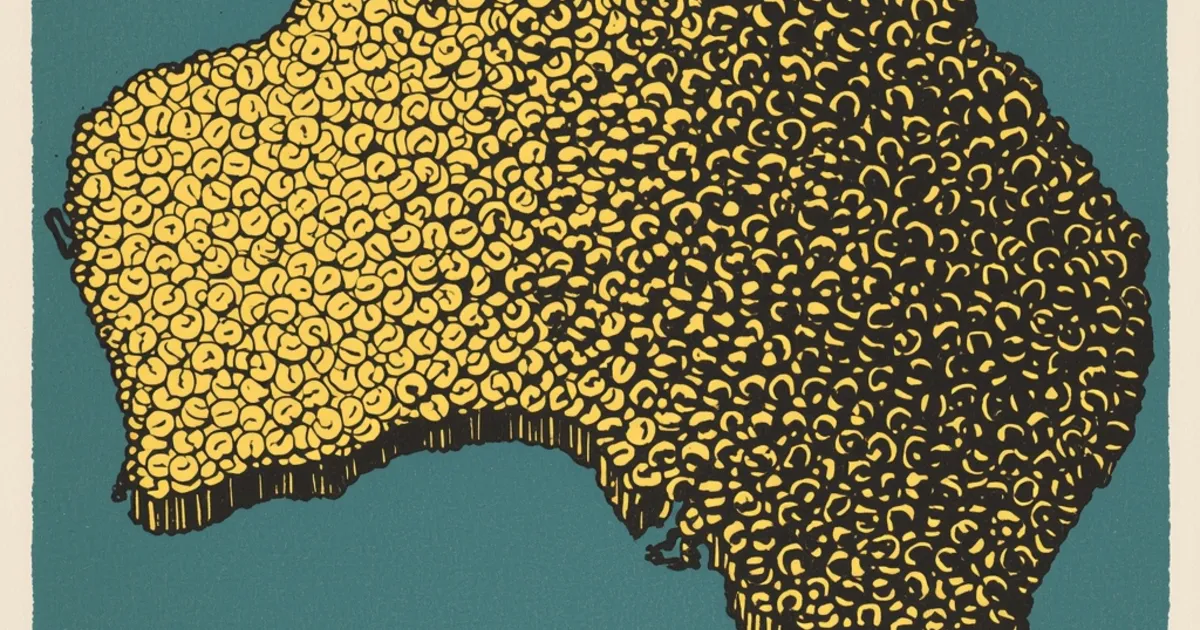
Australian households own about $19.4 trillion. Pay off the national debt,
fund the government for five years, and there's still enough to set every Australian up
with a home, an income and five years to think. Nobody is proposing to do it tomorrow. The
thought experiment asks a better question: if the wealth is here, why do we act poor?
This is a thought experiment. It runs the numbers as if the wealth could
be shared, to see what the country could look like and why it doesn't.
The number
Every quarter the Australian Bureau of Statistics adds up everything households own,
minus what they owe. In June 2026 the total reached $19,388.9 billion
(ABS, 2026). That's about $700,000 for every person in the country.
Meanwhile the federal government owes $928.6 billion (Commonwealth of Australia, 2025).
A country this rich is also in debt, and is told regularly that it can't afford housing,
care or a decent income for the people who have least.
The experiment
Take the wealth and run it in four steps.
- Clear the debt. Pay off what the government owes, so no interest leaves
the country.
- Fund the government for five years. Hospitals, schools, roads and
pensions paid in advance, so nothing essential stops.
- Set every person up. Each Australian gets three things: an
income-producing asset worth about $150,000, a housing asset worth about $150,000, and the
rest as a weekly income for five years.
- Take a break. For those five years the country does only what keeps it
alive: food, health, power, water, care, repairs. Everyone shares that work, about 20 hours a
week each. Think of the COVID lockdowns, with the night life left on.
Then use the time. Five years in which nobody is afraid of losing their home, to rest, and
to work out together how the country should run next.
Where the money actually is
Almost none of the $19 trillion sits in a bank. The ABS breaks it down:
| What households own | June 2026 |
|---|
| Land and homes | $12,904.8 billion |
| Superannuation | $4,704.1 billion |
| Owed on loans (subtracted) | $3,521.1 billion |
And it isn't spread evenly. In the most recent full survey, the wealthiest fifth of
households held 63% of all household wealth, an average of $3.27 million each. The least
wealthy fifth held 0.7%, an average of $35,100 (ABS, 2022).
That's why the experiment can't be switched on. The wealth already has owners, most of it
is the price of land, and a price isn't cash. Sharing it now would mean taking it, and that
would tear the country apart before anyone got a break. The figures are sound. The disruption
is the problem.
Why doesn't it exist already?
Because the moment to share wealth is before it's claimed. One country took that moment.
Norway struck oil in the North Sea and decided the money belonged to
everyone, including people not yet born. Since 1990 its petroleum income has gone into a
public fund, now worth more than US$2.2 trillion and owning about 1.5% of all the world's
listed companies. The government may spend only about 3% of it a year, so the fund keeps
growing for the next generation (Wikipedia, 2026a).
That choice fits the culture. Norwegians have a word, dugnad, for unpaid work
done together: clearing the school yard, painting the club house. It was voted the word of
the year in 2004, and in 2020 the government used it to ask the whole country to shut down
together against COVID (Wikipedia, 2026b). A people who already think of shared work as
normal found it natural to treat oil as shared wealth.
The same thinking runs through the rest of the country. Norway's prisons are built on a
"principle of normality": "the smaller the difference between life inside and outside the
prison, the easier the transition from prison to freedom" (Wikipedia, 2026d). The person inside
is going to be someone's neighbour again. And Norway has topped the World Press Freedom Index
for years, with news kept free of VAT and public funding kept away from editors
(Reporters Without Borders, 2026). A press that can't be bought makes a public fund much harder
to raid quietly.
Australia dug up just as much, and more: iron ore, coal and gas. It
never built a fund owned by the people. The closest thing, the Future Fund, started in 2006
with $18 billion from budget surpluses and the sale of Telstra. Its job is to pay the
pensions owed to retired public servants, not to pay Australians a share (Wikipedia, 2026c).
The resource booms came and went, and the debt stayed.
Australia did try once. In 2012 it began taxing 30% of the "super profits" from iron ore and
coal. The tax was forecast to raise $22.5 billion over four years; it raised $126 million in its
first six months, and it was repealed in 2014 (Wikipedia, 2026e).
Part of the reason is how closely the people who decide these things and the industry they
decide on are tied. A few of the moves from one side to the other:
| Politician | In office | Afterwards |
|---|
| Ian Macfarlane | Federal Minister for Industry when the mining tax was repealed
(2014) | Chief executive of the Queensland Resources Council from 2016 |
| Martin Ferguson | Federal Minister for Resources and Energy, 2007–2013 |
Chair of the advisory board of the oil and gas industry's peak body, APPEA |
| Ben Wyatt | Treasurer of Western Australia, left politics in 2021 |
Joined the boards of Woodside and Rio Tinto in 2021 |
| Mark McGowan | Premier of Western Australia, left office in 2023 |
Has advised BHP and Mineral Resources |
(Wikipedia, 2026f)
None of this breaks a rule. That's the point: the system allows it, so for the people who
set the rules on a resource, the industry is often where the next job is. A country where that path is normal
will find it hard to put resource wealth into a fund owned by everyone.
What we can do instead
If the wealth can't be handed out, the same goals can be reached more gently.
- Reward cooperation. Build arrangements where people do better by
working together and sharing ownership and the returns, instead of competing for a fixed
pie. How people respond to that is in
Does competition make people perform
better?
- Cut the work that produces nothing. Every hour spent on reports nobody
reads and meetings about meetings is an hour that could come back to someone as time.
- Pool new wealth before it's claimed. The next resource boom, and the
next, can still go into a fund that belongs to everyone.
The $19 trillion experiment is a step, not a destination. It shows the money exists, and
it asks why a country this rich lives as if it were poor. Next time someone says "we can't
afford it", ask who the "we" is.
Sources
- Australian Bureau of Statistics. (2026). Australian national accounts: Finance and
wealth, June 2026. abs.gov.au
- Australian Bureau of Statistics. (2022). Household income and wealth, Australia,
2019–20. abs.gov.au
- Commonwealth of Australia. (2025). Gross debt as at 30 June 2025, tabled in
Australian government debt. wikipedia.org
- Wikipedia. (2026a). Government Pension Fund of Norway. wikipedia.org
- Wikipedia. (2026b). Dugnad. wikipedia.org
- Wikipedia. (2026c). Future Fund. wikipedia.org
- Wikipedia. (2026d). Halden Prison. wikipedia.org
- Wikipedia. (2026e). Minerals Resource Rent Tax. wikipedia.org
- Wikipedia. (2026f). Ian Macfarlane (Australian politician); Martin Ferguson (politician); Ben Wyatt (politician); Mark McGowan. wikipedia.org
- Reporters Without Borders. (2026). Norway, World Press Freedom Index. rsf.org