They tend to last longer, and they hold up at least as well as ordinary firms.
Across a large French sample, worker-owned firms produced as much as conventional ones, or
more. In Uruguay they were 29% less likely to close. And in Spain's Basque Country, a network
begun by a priest and five young people now employs about 70,000.
The idea
In most businesses, the people who own it and the people who do the work are different
groups. The owners take the profit and the vote. The workers take a wage.
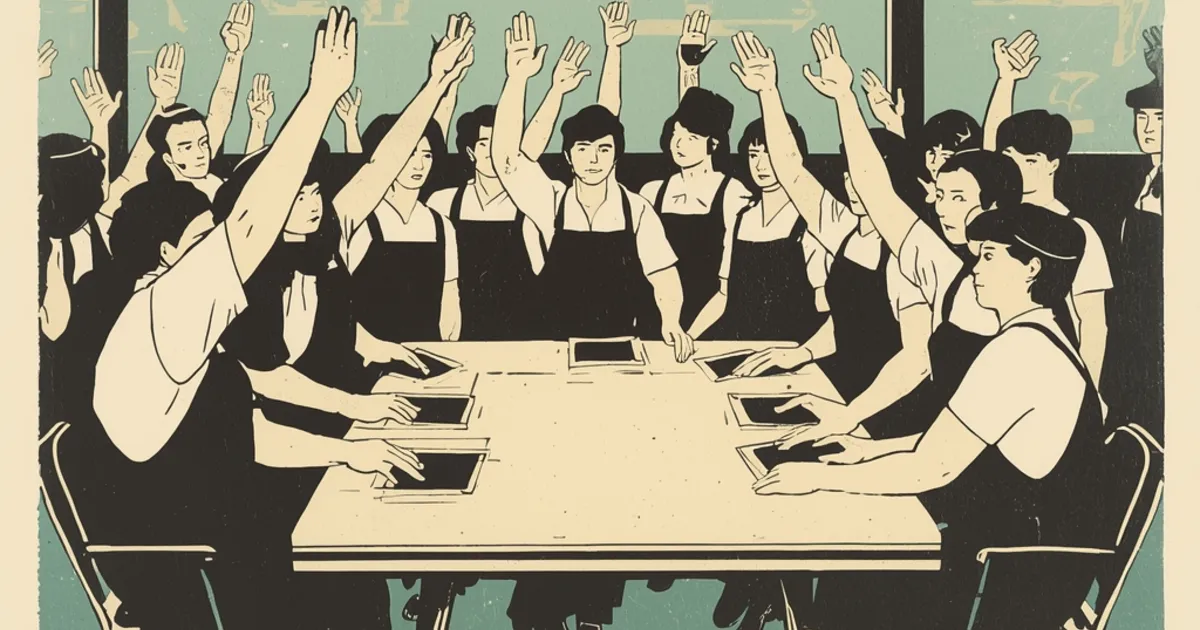
A co-operative joins the two. The people who do the work, or use the service, own the
business together. Each member gets one vote, whatever their stake. The profit goes back to
the people who made it. Cooperation is rewarded directly: the better everyone works together,
the better everyone does.
A priest, a school and five young people
In February 1941 a 26-year-old priest, José María Arizmendiarrieta, arrived in Mondragón, a
Basque town of about 7,000 people still recovering from the Spanish Civil War (Wikipedia,
2026a, 2026b). Four years earlier Arizmendiarrieta spent a month in a Francoist jail for writing for the
newspapers Eguna and Gudari, and faced a court-martial where only 4 of 17 detainees escaped execution
(Wikipedia, 2026b).
In 1943 Arizmendiarrieta opened a technical school with 21 students (Mondragon, 2026b).
In 1956 five young people from the town, Luis Usatorre, Jesús Larrañaga, Alfonso
Gorroñogoitia, José María Ormaetxea and Javier Ortubay, founded Ulgor, a workshop owned by the
people who worked in it (Wikipedia, 2026b). It later became the appliance maker Fagor.
Then came the pieces that let it grow:
- 1958: Lagun Aro, its own welfare fund, which later added unemployment
cover (Mondragon, 2026b).
- 1959: Caja Laboral, a co-op bank that funds new co-ops (Mondragon, 2026b; Wikipedia, 2026a).
- A university, itself a co-operative, that trains the next members
(Wikipedia, 2026a).
How big it got
Today Mondragon is 81 self-governing co-operatives and about 70,000 people, with 104 plants
in 37 countries (Mondragon, 2026a). Its 2024 revenue was €11.2 billion (Wikipedia, 2026a).
Pay stays close together. The gap between the highest and lowest paid runs from 3 to 1 up
to 9 to 1, and averages about 5 to 1. The lowest-paid jobs pay about 13% more than similar
jobs nearby (Wikipedia, 2026a).
What it does in a crisis
The hardest test came when Spain's property bubble burst. In October 2013 Fagor
Electrodomésticos, the co-op that grew from Ulgor, filed for bankruptcy with €1.1 billion in
debt, and 5,600 jobs were at risk (Wikipedia, 2026a).
An ordinary company would have laid them off. Mondragon's other co-ops worked through 2014
"to try to relocate the members affected by the Fagor Electrodomésticos Crisis" (Mondragon,
2026a). It wasn't perfect: worker-owners were placed first, ahead of staff on wages
(Wikipedia, 2026a). The instinct was still to find people work, not to let them go.
The same thinking shows up across worker co-ops in hard times. In an ordinary firm, workers
rarely accept a pay cut, because nothing guarantees the pay comes back, so the firm cuts jobs
instead. In a co-op the workers own the recovery, so they can take a cut together and restore
it later (Wikipedia, 2026c). A co-op paying less in a bad year isn't a worse employer. It's a
group choosing to share the loss instead of handing it all to the people let go.
Why the Basques?
Mondragon didn't grow from nothing. Basque villages have an old custom called
auzolan, "neighbourhood work": unpaid work done by everyone for the whole community.
Villagers built and repaired roads, fountains and churches this way, and rebuilt a
neighbour's house after a fire. The church at Aia went up through auzolan between 1911 and
1913, and homes in the Chantrea neighbourhood of Pamplona in the 1950s (Wikipedia,
2026d).
A people who already built their churches together found it natural to own their factories
together.
What the research says
The usual objection: co-ops are nice, but they can't compete. The best evidence says
otherwise.
| Question | What the study found |
|---|
| Are they as productive? | Using two large French data sets across many industries,
including services, worker co-ops were as productive as conventional firms or more, and used
their inputs efficiently. They were about the same size and grew as fast (Fakhfakh, Pérotin
& Gago, 2012). |
| Do they close sooner? | In a long panel of Uruguayan firms, worker-managed firms
were 29% less likely to close than conventional ones, and the extra survival came with steadier
employment (Burdín, 2014). |
| Why so few, then? | Not because they fail more. Burdín (2014) concludes that low
survival can't explain why worker-managed firms are rare. |
The French study goes further: conventional firms could produce more by organising work the
way the co-ops do (Fakhfakh, Pérotin & Gago, 2012).
Australia already does this
Australia has more than 1,800 co-operatives and mutuals. The largest 100 took in a record
$50.9 billion in the year to June 2025 (Business Council of Co-operatives and Mutuals,
2026).
- CBH Group, Western Australia's grain co-op, has been owned by the
state's grain growers since 1933. It was set up on one person, one vote, no matter how much
grain a farmer delivers (Wikipedia, 2026e). Growers deliver their harvest to more than 100 of
its sites (CBH Group, 2026).
- Norco is a dairy co-op established in
1895 and owned by more than 200 dairy farms (Wikipedia, 2026f).
Most Australians have never heard that these businesses belong to the people who work
them.
What we can do
- Bank, insure and shop with a member-owned business. Customer-owned banks,
mutual insurers and co-op stores exist in most towns. Your custom becomes your share.
- Reward cooperation where you work. Profit sharing, a vote for the people
who do the job, and pay kept close together all move a business towards the co-op model. How
people respond to shared goals is in
Does competition make people perform
better?
- When a business owner retires, ask about the workers. The people who
already run it are often the best buyers.
A priest and five young people started with a workshop in a town still healing from a war.
Seventy years later their idea employs 70,000. The model works. The question is why so few of
us are offered it.
Sources
- Burdín, G. (2014). Are worker-managed firms more likely to fail than conventional
enterprises? Evidence from Uruguay. ILR Review, 67(1), 202–238.
doi.org
- Business Council of Co-operatives and Mutuals. (2026). National mutual economy report
2026. bccm.coop
- CBH Group. (2026). CBH Group. cbh.com.au
- Fakhfakh, F., Pérotin, V., & Gago, M. (2012). Productivity, capital, and labor in
labor-managed and conventional firms: An investigation on French data. ILR Review,
65(4), 847–879. doi.org
- Mondragon Corporation. (2026a). About us. mondragon-corporation.com
- Mondragon Corporation. (2026b). History. mondragon-corporation.com
- Wikipedia. (2026a). Mondragon Corporation. wikipedia.org
- Wikipedia. (2026b). José María Arizmendiarrieta. wikipedia.org
- Wikipedia. (2026c). Worker cooperative. wikipedia.org
- Wikipedia. (2026d). Auzolán [Spanish]. wikipedia.org
- Wikipedia. (2026e). CBH Group. wikipedia.org
- Wikipedia. (2026f). Norco Co-operative. wikipedia.org