
Should high school start later?
Puberty moves the body clock later, and early bells cut teenagers' sleep. When Seattle started an hour later, students slept 34 minutes more.
Photo: Guywelch2000, CC0, via Wikimedia Commons

5 min read
 articleworld4u
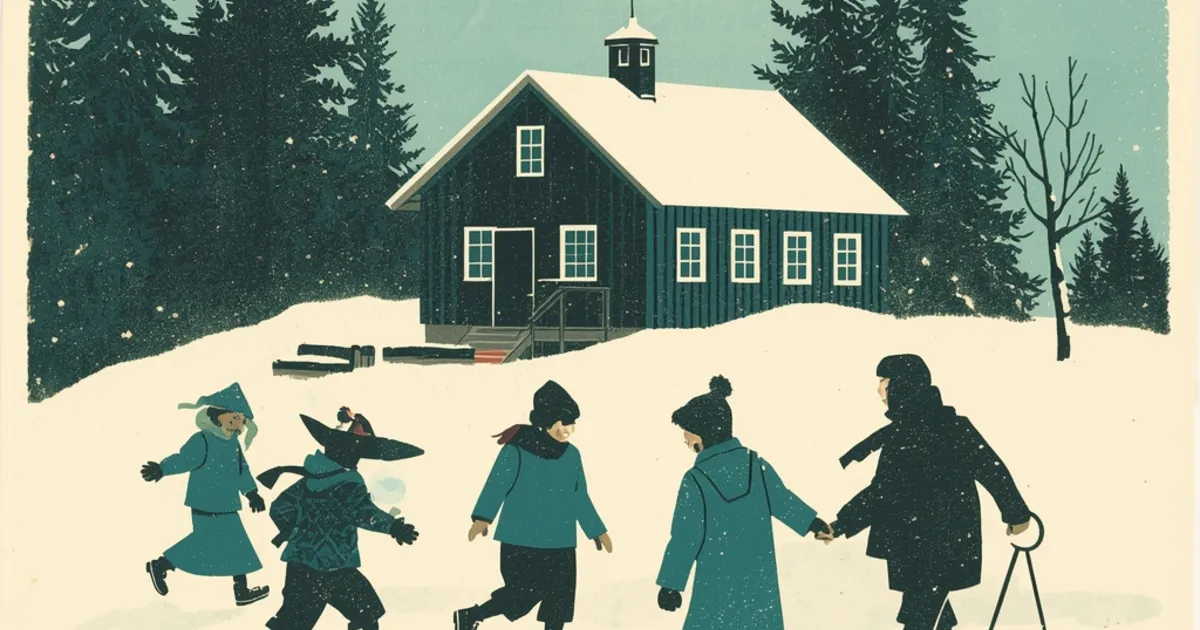
Photo: Leo-setä, CC BY 2.0, via Wikimedia Commons
Finnish children start school at seven, get a break after every 45 minutes of teaching, and sit no national exam that ranks them or their school until the end of high school. Their teachers all hold master's degrees, and there is no fee-paying school tier to escape to. Finland's test scores have fallen a long way since 2006, and critics have theories why. The design still asks a question worth answering: what would a school built on trust and play look like here?
Before seven, children are in early childhood education, which follows a national curriculum built around play. At six they do one year of preschool. Formal school, grade 1, starts at seven (Wikipedia, 2026a).
The days are short. The law caps a first or second grader's day at five lessons, and sets a minimum of 21 lessons a week. A lesson counts as an hour, of which at least 45 minutes must be teaching (Finlex, 1998). The rest is a break. Normally, children and teachers stop for 15 minutes after every 45 minutes of instruction, and children head outside to play, rain or shine, while two teachers take turns watching the playground (Walker, 2014).
Every child gets a free hot lunch, from preschool to the end of high school, guaranteed since 1948 (Wikipedia, 2026b). Classes are seldom bigger than 20, and for nine years nobody is selected, streamed or sorted into ability groups. Young children often get written comments instead of numbered grades (Wikipedia, 2026a).
Finland has no NAPLAN. There are no high-stakes tests in the nine years of basic school (Wikipedia, 2026a). The government does check how the country is going: each evaluation tests a sample of 5 to 10% of pupils, and schools in the sample get their results compared with the national average (FINEEC, n.d.). Nothing is published as a league table.
The first national exam is the matriculation exam, sat at the end of academic upper secondary school and run by a national board since 1919 (Wikipedia, 2026c). It takes at least five subjects, including the student's mother tongue, and opens the door to university (Matriculation Examination Board, n.d.).
Finland also scrapped school inspections in the 1990s. The country set out on purpose to build "trust between educational authorities and schools", with schools planning their own curriculum and their own assessment (Crouch, 2015).
Trust only works if the people trusted are well trained. Every primary and secondary teacher in Finland needs a master's degree (Wikipedia, 2026a). For primary teachers it's a five-year course, and in 2015 the University of Helsinki took only 7% of applicants, leaving more than 1,400 disappointed (Crouch, 2015).
The respect has deep roots. A Helsinki professor of teaching puts it like this: "teachers have always been seen as the people who brought civilisation to small villages" (Crouch, 2015). Literacy runs deep too. Every Finnish baby gets a box from the state, the maternity package, and inside it are three books: one for each parent and one for the baby (Wikipedia, 2026a).
Finnish schools are almost all run by local councils. Private schools are few, need government approval, get the same state grant as a public school, and may not charge fees or pick their students (Wikipedia, 2026a). A wealthy family can't buy a better school, so it has every reason to want the local one to be good.
Australia chose differently. In 2025, 37.2% of students went to Catholic or independent schools (ABS, 2026), and the most expensive private schools charge up to $500,000 for 13 years (Wikipedia, 2026d). Children start the preliminary year of school between four and a half and five and a half. NAPLAN tests every child in Years 3, 5, 7 and 9, and the My School website lets anyone compare schools' averages. Teachers have long worried that it pushes schools to teach to the test (Wikipedia, 2026e).
Timothy Walker, an American, moved to Helsinki to teach fifth grade. The hourly break looked soft. In the United States Walker had kept students in class for hours at a stretch, and believed longer lessons meant more learning. So in the first week Walker held the class back: two lessons in a row, then a double break.
On the third day, one student walked up "like a zombie" with a red rash forming on the child's forehead and said, "I think I'm going to explode! I'm not used to this schedule." Walker gave in and brought the breaks back. For the rest of the year, the children came back from every break "with a bounce in their steps", and they were more focused in lessons (Walker, 2014).
The research agrees. In a series of experiments in a US primary school, children were more attentive after a break than before one, and less attentive when the break came late (Pellegrini, Huberty & Jones, 1995). What matters most is freedom: the break has to be the child's own time, not more instruction outdoors.
Finland became famous for its PISA results, the OECD test of 15-year-olds. It hasn't held the top spot for years.
| PISA mean score | 2006 | 2022 | 2025 |
|---|---|---|---|
| Finland, maths | 548 | 484 | 469 |
| Finland, reading | 547 | 490 | 474 |
| Finland, science | 563 | 511 | 504 |
| Australia, maths | 520 | 487 | 478 |
(Wikipedia, 2026f; OECD, 2026)
In 2025 Australia scored higher than Finland in all three subjects. Finland's own education ministry admitted in 2023 to an "exceptionally rapid drop" in reading and maths (Wikipedia, 2026a).
Critics read this in different ways. The economist Gabriel Heller Sahlgren argues that Finland's rise began before most of its famous reforms, and came from history, economics and an older, teacher-led culture. On this view the decline came with newer, pupil-led methods, and other countries should be careful what they copy (Heller Sahlgren, 2015). Others point out that scores have fallen in many countries, including Australia, which tests every child and still lost 42 points in maths between 2006 and 2025.
Two things are fair to say. The Finnish model doesn't guarantee top scores. And Finland fell from the top to about where Australia sits, with shorter days, later starts, hourly play and no league tables. A country can drop the pressure and still land in the same place.
Most of Finland's design costs little money: a later start, a break every hour, trust instead of rankings. What it costs is a change of mind. It asks a country to treat teachers as experts, to treat play as part of learning, and to give up the fee-paying school as a way out. The history of why our schools look the way they do is in Was school designed to make children obedient?
Something you can check this week: ask your child's school how many minutes of free play a child gets in a day, and how many of those minutes are outdoors. Then add up the Finnish figure, about 15 minutes in every hour, and compare.
Puberty moves the body clock later, and early bells cut teenagers' sleep. When Seattle started an hour later, students slept 34 minutes more.
Photo: Guywelch2000, CC0, via Wikimedia Commons
In 1998, 42% of Icelandic 15-year-olds had been drunk in the past month. Iceland paid for sport, music and art, and parents agreed on rules. Drinking fell.
Photo: IngimarE, CC BY-SA 4.0, via Wikimedia Commons
Compulsory schooling began in 1760s Prussia as a tool of royal authority. What that history explains, what it doesn't, and what the evidence says works.
Photo: Johann Peter Hasenclever, Public domain, via Wikimedia Commons

