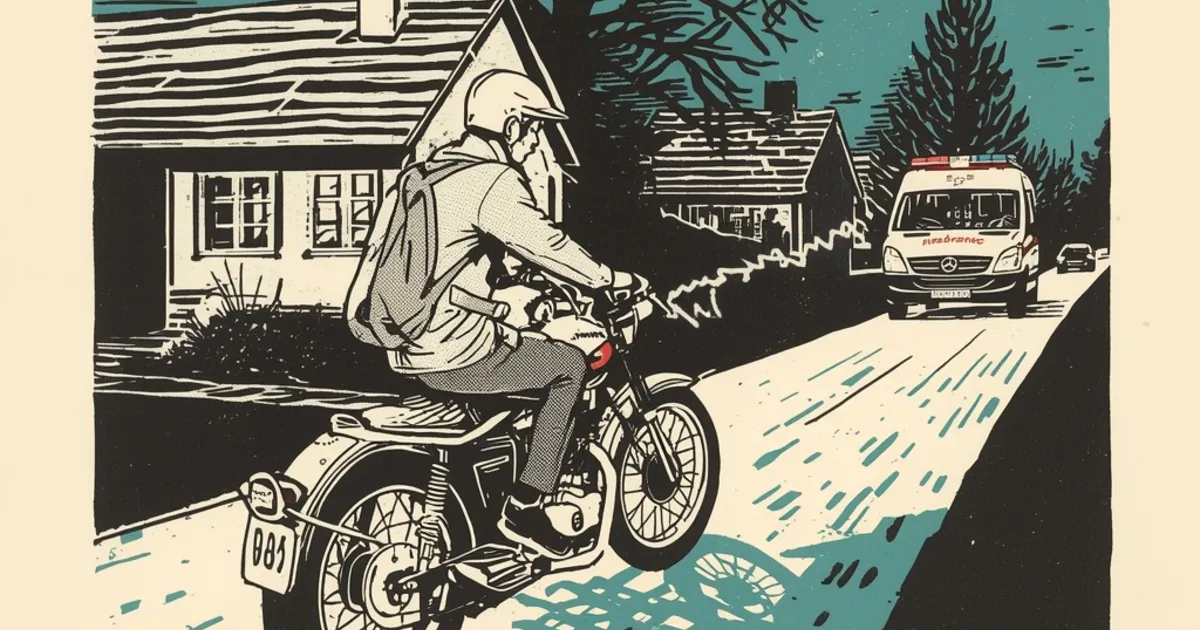
When a heart stops, the person who saves it is usually the one closest,
not the one best qualified. Israel built a volunteer service around that idea and reaches
emergencies in under three minutes. Victoria and Western Australia already alert nearby
volunteers to cardiac arrests. What holds them back is simple: not enough of us have
signed up.
This is a thought experiment with real parts. Every piece of it already
works somewhere. The question is why it doesn't work everywhere.
The experiment
Picture a street where a triple zero call for a collapse lights up the phones of trained
neighbours within a short walk. One of them is at the door within a
minute or two, starts CPR, and someone else runs to the nearest defibrillator. The ambulance
still comes. The neighbours fill the minutes before it arrives.
Those minutes decide everything. Ambulance Victoria puts it plainly: every minute without
CPR or defibrillation lowers the chance of survival by 10% (Ambulance Victoria, 2025). An
ambulance can't be on every corner. A neighbour already is.
What a stranger's CPR is worth
Sweden has trained about three million people in CPR. Researchers there studied 30,381 witnessed cardiac arrests over 22 years. When
someone started CPR before the ambulance arrived, 10.5% of patients were alive a month later.
When nobody did, 4.0% were. After allowing for age, location, cause and response time, CPR
before the ambulance still more than doubled the odds of survival (Hasselqvist-Ax et al.,
2015).
The same team then tested the idea directly. In Stockholm, when an
ambulance was dispatched to a cardiac arrest, a phone system found trained volunteers within
500 metres. A random draw decided whether it sent them. Where
volunteers were sent, bystanders started CPR in 62% of cases. Where they weren't, 48%
(Ringh et al., 2015). Fourteen more people in every hundred got CPR, just because a phone
buzzed nearby.
Israel: an ambulance on two wheels
Eli Beer grew up in Jerusalem. At six, walking home from school with his brother, he saw
a bus blow up at a bus stop. An old man cried out for help, and the two boys, terrified, ran.
At 15 Beer trained as an emergency medical technician and volunteered on an ambulance. In two
years, by his own account, the ambulance never got there in time for the people who most
needed it (Beer, 2013).
Then came a call about a seven-year-old choking on a hot dog. Traffic was terrible; the crew
arrived 20 minutes later and started CPR. A doctor who lived one block away came in, checked
the child, and told them to stop. The child was dead. Beer's conclusion: if that doctor had
known 20 minutes earlier, the child would have lived (Beer, 2013).
At 17, Beer asked the local ambulance manager to page him and 15 friends to emergencies in
their neighbourhood. The manager said no. So Beer bought two police scanners and listened for
calls himself. The next day he heard of a 70-year-old man hit by a car a block away. He ran
there with no equipment, found the man bleeding from the neck, and pressed his yarmulke to the
wound until the ambulance arrived 15 minutes later. It was the first life he had saved (Beer,
2013).
That group became United Hatzalah, formed in 2006 when more than 50 local volunteer groups
merged. Today it has over 8,000 volunteers who respond free of charge, to anyone. A GPS app
sends the closest volunteers to each call, and about 1,000 of them ride "ambucycles":
motorbikes carrying medical gear and a defibrillator, which weave through traffic the
ambulance sits in. The service reports an average response under three minutes across Israel
and 90 seconds in cities (Wikipedia, 2026a). As Beer says, they aren't there to replace
ambulances, only to close the gap until one arrives (Beer, 2013).
Who turns up
The idea of neighbourhood volunteer medics began in Jewish communities in Brooklyn. A few
years after Beer started, two Muslim men from East Jerusalem, Muhammad Asli and Murad Alyan,
asked to meet him. Asli's father had collapsed at home with a cardiac arrest; the ambulance
took over an hour, and Asli watched him die. Beer's answer was to start the service in East
Jerusalem too: "It's not about saving Jews. It's not about saving Muslims. It's not about
saving Christians. It's about saving people" (Beer, 2013).
Communities that often don't get along found a common cause. Jewish settlers treated Arab patients, and Arab volunteers treated settlers. By
2018 its volunteers were about 60% religious Jews, 30% secular Jews and 10% Muslim, Christian
and Druze, and it is the only Hatzalah group in the world that includes women and non-Jewish
volunteers (Wikipedia, 2026a). Years later, Beer's own father collapsed with a cardiac arrest.
One of the first volunteers to reach him, and save him, was a Muslim man from East Jerusalem
from that first course (Beer, 2013).
Australia already does this, on the beach
Australians don't need to be sold the idea. In 1907, as drownings rose on newly opened surf
beaches, volunteers began patrolling and formed the Bondi Surf Bathers' Life Saving Club.
Surf Life Saving Australia now has over 180,000 members, about 45% of them women. Volunteers provide most of its patrols, and it has rescued over 650,000 people (Wikipedia, 2026b). We already accept that the
person on the sand, not the ambulance on the road, gets to a drowning swimmer first.
The same idea now works on land:
| Scheme | How it works |
|---|
| GoodSAM, Victoria | A free app run with Ambulance Victoria. When someone calls
triple zero for a cardiac arrest, registered responders nearby get the patient's location and
the nearest defibrillator, and start CPR while the ambulance is on its way (Ambulance
Victoria, 2025). |
| St John First Responder app, Western Australia | Qualified first aiders register
as Community First Responders and are alerted to medical emergencies within 500 metres. The
network lists more than 10,000 registered defibrillators (St John WA, n.d.-a, n.d.-b). |
GoodSAM began in the United Kingdom in 2013 and is used by London Ambulance Service,
Ambulance Victoria and St John New Zealand, among others (Wikipedia, 2026c).
Does it work here?
Yes, when a volunteer gets there first. Researchers studied 9,196 cardiac arrests in
Victoria between 2018 and 2023. When a GoodSAM responder arrived before the ambulance, the
patient had higher odds of surviving to leave hospital (adjusted odds ratio 1.37), about
7.6 times the odds of getting CPR from a bystander, and 16 times the odds of a bystander
using a defibrillator. When the responder arrived after the ambulance, it made no difference
(Delardes et al., 2025).
That last finding matters. The benefit comes from being close, not from being there at all.
And the same study shows the gap: responders attended only 12.6% of cardiac arrests, and beat
the ambulance in about half of those. An editorial alongside it named the fix: more
responders, so one is always near (Morrison & Simpson, 2025).
So the technology works and ambulance services back it. What's missing is enough of us
within a short walk of every door.
Will it be too much?
A common worry is that arriving at a cardiac arrest will haunt you. A survey of nearly 2,000
alerted responders in Victoria and New Zealand checked for this. Of 1,443 who answered the
follow-up, one screened positive for probable post-traumatic stress. Researchers called
the risk "very low" and reassuring. The same survey found that responders who had done CPR
before were more than twice as likely to give care, so practice helps (Haskins et al.,
2021).
And you can always decline an alert. Safety comes first.
What you can do
- Learn CPR. Book a first aid course, such as one run by St John. Sweden shows what a trained
population does for survival.
- Sign up. In Victoria, download GoodSAM, register as a responder and turn
on "report on duty". In Western Australia, download the St John First Responder app and
register as a Community First Responder.
- Register a defibrillator. If your workplace, club or school has one, add
it to your state's network so the next responder can find it.
- Bring someone. Every neighbour who signs up shrinks the distance for
everyone else. People help more than the myths suggest; see
Do bystanders really stand by and do nothing?
Eli Beer started with 15 friends and two police scanners. A street needs only a few people
willing to run.
Sources
- Ambulance Victoria. (2025). GoodSAM. ambulance.vic.gov.au
- Beer, E. (2013). The fastest ambulance? A motorcycle [Video]. TEDMED. ted.com
- Delardes, B., Gregers, M. C. T., Nehme, E., Ray, M., Hall, D., Walker, T., Anderson, D., Okyere, D., Dantanarayana, A., & Nehme, Z. (2025). Smartphone-activated volunteer responders and survival to discharge after out-of-hospital cardiac arrests in Victoria, 2018–23: An observational cohort study. Medical Journal of Australia, 222(10), 504–509. doi.org/10.5694/mja2.52673
- Haskins, B., Nehme, Z., Dicker, B., Wilson, M. H., Ray, M., Bernard, S., Cameron, P., & Smith, K. (2021). A binational survey of smartphone activated volunteer responders for out-of-hospital cardiac arrest: Availability, interventions, and post-traumatic stress. Resuscitation, 169, 67–75. doi.org/10.1016/j.resuscitation.2021.10.030
- Hasselqvist-Ax, I., Riva, G., Herlitz, J., Rosenqvist, M., Hollenberg, J., Nordberg, P., Ringh, M., Jonsson, M., et al. (2015). Early cardiopulmonary resuscitation in out-of-hospital cardiac arrest. New England Journal of Medicine, 372(24), 2307–2315. doi.org/10.1056/NEJMoa1405796
- Morrison, A., & Simpson, P. (2025). Optimising the impact of smartphone-activated volunteer responder programs on out-of-hospital cardiac arrest outcomes by increasing responder density. Medical Journal of Australia, 222(10), 502–503. doi.org/10.5694/mja2.52674
- Ringh, M., Rosenqvist, M., Hollenberg, J., Jonsson, M., Fredman, D., Nordberg, P., Järnbert-Pettersson, H., Hasselqvist-Ax, I., et al. (2015). Mobile-phone dispatch of laypersons for CPR in out-of-hospital cardiac arrest. New England Journal of Medicine, 372(24), 2316–2325. doi.org/10.1056/NEJMoa1406038
- St John WA. (n.d.-a). St John First Responder app. stjohnwa.com.au
- St John WA. (n.d.-b). Community First Responder. stjohnwa.com.au
- Wikipedia. (2026a). United Hatzalah. wikipedia.org
- Wikipedia. (2026b). Surf Life Saving Australia. wikipedia.org
- Wikipedia. (2026c). GoodSAM. wikipedia.org