Loneliness raises the risk of dying early about as much as other major health
risks, yet a GP visit usually ends with a script for a pill. England now pays people to write a
different kind of prescription: a choir, a garden group, a club. Australia already built one of
the best things to prescribe, the men's shed. The missing piece is the hand that joins the two.
This is a thought experiment with real parts. Each piece already works
somewhere. The question is why they don't work together everywhere.
The experiment
Picture a GP visit that ends differently. A retired man comes in with poor sleep and a low
mood. He lost his wife last year and hasn't left the house much since. The GP writes a note, and
by the end of the week someone from the practice has rung him, asked what he used to enjoy, and
walked him through the door of the local men's shed. Six months on, he's there three mornings a
week, fixing bikes for the primary school.
Nothing in that story is new medicine. It treats loneliness as the health risk it is (see
Is loneliness really as bad for your health as
smoking?) and answers it with people instead of pills.
What England built
The idea is called social prescribing: a doctor or nurse refers a patient to
something non-medical in the community, such as art classes, cycling lessons, museum visits,
volunteering or a befriending service (Wikipedia, 2026a). One UK commission estimated in 2015
that about one GP consultation in five was for a social problem, not a medical one (Wikipedia, 2026a).
The key role is the link worker. A link worker sits with the patient, works
out what matters to them, and connects them to local groups. England made the role part of
ordinary general practice: from 2019/20 the NHS funded primary care networks to employ social
prescribing link workers (Wikipedia, 2026b).
It came from grief turned into policy. MP Jo Cox set up a commission on loneliness shortly
before she was killed in 2016. Colleagues from both major parties finished its work, and in
January 2018 Prime Minister Theresa May accepted its recommendations and gave a minister
responsibility for loneliness. The first was Tracey Crouch. In October 2018 the UK became the
first country to publish a national loneliness strategy, with commitments from nine government
departments, including encouraging GPs to refer lonely patients to local groups (Wikipedia,
2026c).
Japan followed. In February 2021, as its suicide rate rose during the COVID-19 pandemic, the
government appointed Tetsushi Sakamoto as its first Minister of Loneliness (Wikipedia, 2026d,
2026e).
Does it work?
The honest answer: promising, and not yet proven.
| What was tested | What researchers found |
|---|
| 15 UK social prescribing programmes (2017 review) | Most reported good results, but
all were small and at high risk of bias. The evidence can't yet judge success or value for money
(Bickerdike et al., 2017). |
| 118 UK reports on link workers (2020 review) | Link workers help people build
trust, belonging and practical support, which gives them the confidence to manage their own
wellbeing (Tierney et al., 2020). |
| Group singing for 258 people aged 60+ (randomised trial) | Better mental
health-related quality of life at six months, less anxiety and depression at three months, and
slightly more cost-effective than usual activities (Coulton et al., 2015). |
| Gardening (2017 meta-analysis) | Gardening benefits health across a range of
outcomes (Soga et al., 2017). |
| 52 studies of men's sheds (2022 review) | Evidence of benefits for self-rated
health, social isolation and wellbeing; stronger long-term studies still needed (Foettinger et
al., 2022). |
Two points stop that table being misread. First, "not proven" isn't "doesn't work". Most
of these programmes are small and local, and the reviews ask for bigger, longer, controlled
studies, not for the programmes to stop.
Second, a referral only helps someone who can take it up. Researchers found that the same
social conditions that harm people's health also make it harder to join in (Gibson et al.,
2021). Handing out referrals alone won't close the gap
between rich and poor areas (Moscrop, 2023). Link workers need time, and groups need to be close
and cheap.
Australia's answer: the shed
In 1993 Maxine Chaseling was running activities for older people at The Heritage Club in
Goolwa, South Australia. Her father had a heart attack, couldn't work, and sank into depression.
The one thing that still gave him purpose was his shed. She noticed the men at the club looked
just as lost, so on 3 March 1993 she opened a shed for them. It worked, and the idea spread to
Langhorne Creek, then across the country (Wikipedia, 2026f). "I struck the match," she said
later, "but fortunately it was the right time and the primary health strategy was simple and
doable in any community."
The Australian Men's Shed Association formed in 2007. It now counts more than 1,300 sheds and
more than 60,000 members, and points out, proudly, that Australia has more men's sheds than
McDonald's restaurants. More than 2,500 sheds now run in 12 countries (Australian Men's Shed
Association, 2026).
Shoulder to shoulder
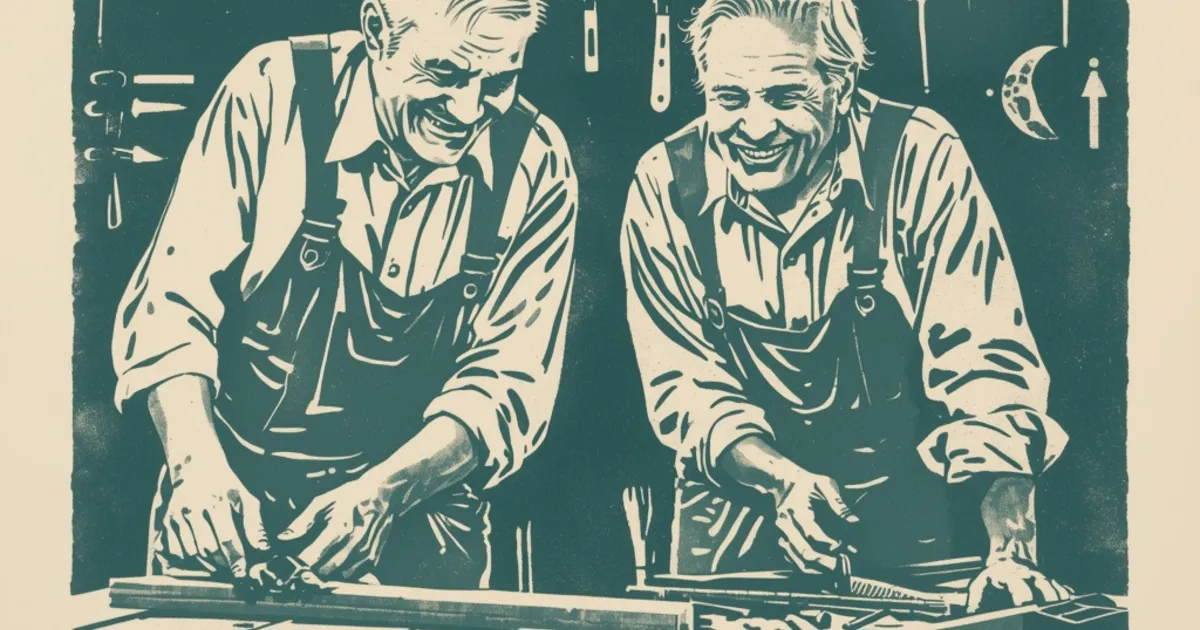
The shed movement's slogan explains why it works where a support group might not. It's
"Shoulder to Shoulder", short for "Men don't talk face to face, they talk shoulder to shoulder"
(Wikipedia, 2026f).
That's Australian mateship in one line. Many blokes won't sit in a circle and share their
feelings. Put them side by side over a workbench, with a job to finish and a cuppa going cold,
and the talk comes on its own: about a diagnosis, a divorce, a son who won't ring. Nobody calls
it therapy. The work gives people a reason to turn up, and turning up again and again, beside
the same faces, is what builds trust. The shed didn't need a trial to find that out. A woman
watched her dad and trusted what she saw.
Why isn't it on every prescription pad?
England built the link but had to find things to link to. Australia grew the things to link
to, from the ground up, without the link. Now the two are starting to meet. Victoria's Royal
Commission into its mental health system recommended a social prescribing trial in each region,
aimed especially at older Victorians, and trials are planned in six local services, from
Frankston to Geelong-Queenscliffe (Wikipedia, 2026a).
What slows it is how health spending is counted. A pill has a price and a trial. A choir has
a volunteer conductor and a hall that needs a new roof. When only one of those counts as
health care, the system keeps buying the pill.
What you can do
- Ask your GP. If you or someone you care for feels cut off, say so, and ask
whether the practice can refer you to local groups.
- Find a shed. Search the Australian Men's Shed Association site for one near
you. Some community sheds now welcome anyone, whatever their age or gender.
- Bring someone. The first visit is the hardest. Offer to go with a friend,
a parent or a neighbour who lives alone.
- Back the groups. A local choir, community garden or shed runs on small money
and volunteer hours. Both count as health care.
England pays people to make the introduction. In Goolwa, one woman did it because she loved her
dad. Either way, the prescription is the same: somewhere to go, something to do, and people
beside you.
Sources
- Australian Men's Shed Association. (2026). Australian Men's Shed Association. mensshed.org
- Bickerdike, L., Booth, A., Wilson, P. M., Farley, K., & Wright, K. (2017). Social prescribing: Less rhetoric and more reality. A systematic review of the evidence. BMJ Open, 7(4), e013384. https://doi.org/10.1136/bmjopen-2016-013384
- Coulton, S., Clift, S., Skingley, A., & Rodriguez, J. (2015). Effectiveness and cost-effectiveness of community singing on mental health-related quality of life of older people: Randomised controlled trial. British Journal of Psychiatry, 207(3), 250–255. https://doi.org/10.1192/bjp.bp.113.129908
- Foettinger, L., Albrecht, B. M., Altgeld, T., Gansefort, D., Recke, C., Stalling, I., & Bammann, K. (2022). The role of community-based men's sheds in health promotion for older men: A mixed-methods systematic review. American Journal of Men's Health, 16(2). https://doi.org/10.1177/15579883221084490
- Gibson, K., Pollard, T. M., & Moffatt, S. (2021). Social prescribing and classed inequality: A journey of upward health mobility? Social Science & Medicine, 280, 114037. https://doi.org/10.1016/j.socscimed.2021.114037
- Moscrop, A. (2023). Social prescribing is no remedy for health inequalities. BMJ, 381, p715. https://doi.org/10.1136/bmj.p715
- Soga, M., Gaston, K. J., & Yamaura, Y. (2017). Gardening is beneficial for health: A meta-analysis. Preventive Medicine Reports, 5, 92–99. https://doi.org/10.1016/j.pmedr.2016.11.007
- Tierney, S., Wong, G., Roberts, N., Boylan, A.-M., Park, S., Abrams, R., Reeve, J., Williams, V., & Mahtani, K. R. (2020). Supporting social prescribing in primary care by linking people to local assets: A realist review. BMC Medicine, 18, 49. https://doi.org/10.1186/s12916-020-1510-7
- Wikipedia. (2026a). Social prescribing. wikipedia.org
- Wikipedia. (2026b). Primary care network. wikipedia.org
- Wikipedia. (2026c). Jo Cox Commission on Loneliness. wikipedia.org
- Wikipedia. (2026d). Tetsushi Sakamoto. wikipedia.org
- Wikipedia. (2026e). Suicide in Japan. wikipedia.org
- Wikipedia. (2026f). Men's shed. wikipedia.org



,_Mo_i_Rana,_Norway_2017-10-09_a.jpg)

