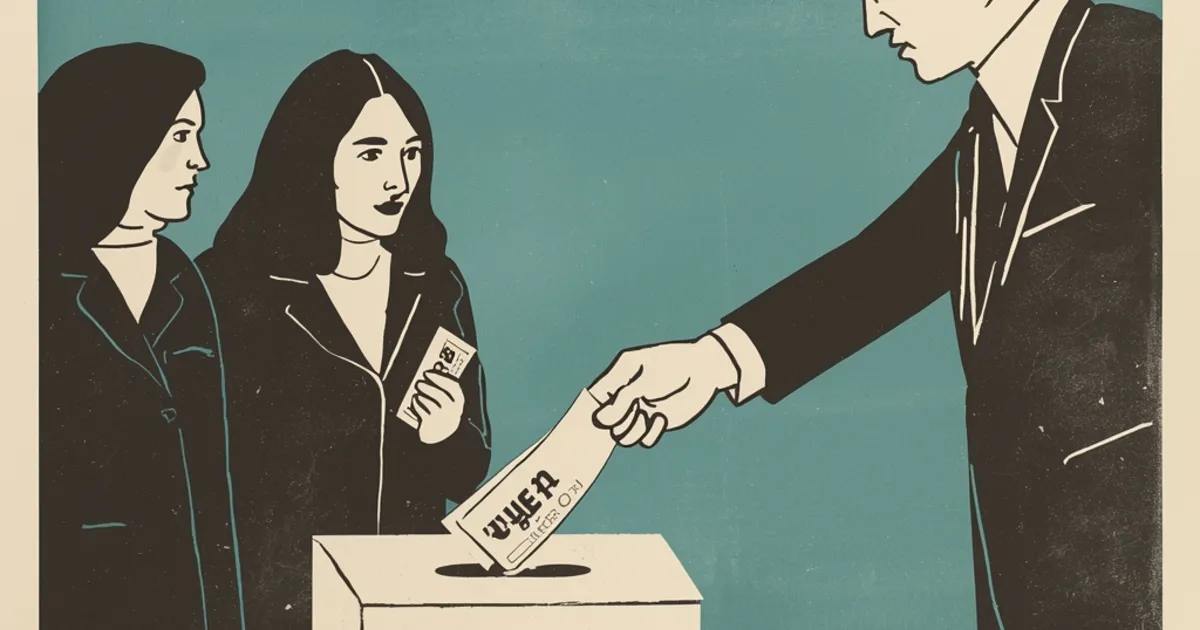
Give every enrolled Australian $50 of public money, to hand to any candidate
they choose. Cap what anyone else can give, publish donations within days, and open
ministers' diaries. Money would still matter in politics, but it would come mostly from
voters, in equal shares. Seattle has done the voucher part since 2017, and its voters just
chose to keep it.
This is a thought experiment built on reforms that already exist
somewhere. Most of the ideas come from Joo-Cheong Tham, a law professor at the University of
Melbourne who has written on political money since at least 2010.
The problem, in three words
Tham sums up what goes wrong when money in politics is left alone: secrecy, corruption
and unfairness (Tham, 2018).
- Secrecy. Malcolm Turnbull gave the Liberal Party $1.75 million for the
2016 election. The public learnt of it more than a year and a half after the vote
(Gothe-Snape, 2018).
- Corruption. Not usually a bribe. The High Court calls the danger
"clientelism": an office holder who depends on a wealthy patron. Who gets heard as a result
is in Who gets heard in Australian
politics?
- Unfairness. With no spending limits, Clive Palmer spent about
$60 million on the 2019 federal election (Wikipedia, 2026a). His party won no seats. What
would the same money do for a cause with no billionaire behind it?
The fixes that already have a name
Tham's plan has ten points for election money and ten for lobbying. Five of them do most
of the work.
| Reform | What it does | Where Australia is |
|---|
| Donation caps | Limits what one donor can give, so no party depends on a
few patrons. Tham suggests phasing down to $2,000 a year. | From 1 January 2027:
$50,000 a year to one recipient, $1.6 million in total (AEC, 2026). |
| Spending caps | Stops elections becoming an auction. | From 2027:
$90 million per party nationally, $800,000 per electorate (AEC, 2026). |
| Fast disclosure | Voters see who paid before they vote, not a year later. |
From 2027: donations above $5,000 (down from $17,300), reported within 7 days during an
election and within 24 hours in the final week (AEC, 2026). |
| Public funding | Pays for campaigns so parties need donors less. Tham wants
about half of party income public. | Paid since 1984 to candidates who win 4% of
first preferences, now $3.583 a vote, with rises to come (AEC, 2026; Wikipedia, 2026b). |
| Open ministers' diaries | Shows who met whom, and about what. |
Queensland and NSW publish them (Wood et al., 2018). Tham wants federal ministers,
shadow ministers and their chiefs of staff to publish every quarter. |
Tham adds one idea that deserves more attention. For any big decision, the government
publishes a statement listing the meetings held, a summary of what the lobbyists argued, and
what the public service advised. If the minister ignored that advice, the statement says why.
Nobody has to guess who was in the room; it's written down with the decision.
The idea nobody in Australia has tried: democracy dollars
Caps and disclosure stop the worst money. Public funding replaces some of it. Neither
changes who decides where the money goes. Vouchers do.
US law professor Richard Hasen argued for campaign vouchers in 1996: give every voter the
same small amount of public money to spend on politics, so the poorest voter has as much
to give as the richest (Hasen, 1996). Tham's plan points the same way from another angle. It
would replace today's tax deduction for political donations, worth up to $1,500 a year and
so worth most to people who can afford to give, with public credits that match what supporters
give (Tham, 2018; Wikipedia, 2026b).
Run the numbers
On 30 June 2026, 18,367,806 Australians were enrolled to vote (AEC, 2026b). Give each
one $50 per federal election and the total is about $918 million, roughly $300 million for
each year of a three-year term.
That's more than 20 times the $43 million parties declared in donations at the 2016
federal election (Wood et al., 2018). In a voucher system the biggest source of campaign money
is voters, in equal shares. A $50,000 cheque still counts, but it's a small voice in a large
crowd.
Seattle did it
In 2015 Seattle voters passed Initiative 122. Since the 2017 city elections every
eligible resident has received four $25 vouchers to give to local candidates. Candidates
who take vouchers agree to stricter limits and can't spend them on salaries, family or other
campaigns. A property tax pays for it (Seattle Ethics and Elections Commission, 2026;
Wikipedia, 2026c).
What happened:
- More people gave. During the primaries, the share of residents giving
to a campaign rose from 1.5% in 2017 to 3.6% in 2021 (Wikipedia, 2026c).
- More people ran. An economic study found unique donors rose about
350% and the number of candidates about 86%, while incumbents won less often (Griffith &
Noonen, 2022, as summarised in Wikipedia, 2026c).
- Different donors, partly. Voucher users were less likely than cash
donors to be high-income, and more likely to come from poor neighbourhoods (McCabe &
Heerwig, 2019).
It isn't magic. A later study found the people most mobilised by vouchers still came from
groups already over-represented among donors, by income, race, age and past participation
(Yorgason, 2025). Context matters here: voting in Seattle is voluntary. The voucher opened the door to everyone; the people already used to taking part walked through it first. None of these studies tested vouchers in a country
where almost everyone already votes.
Seattle kept it anyway. In 2025 its voters approved a new property tax to fund the
program for another ten years, at $4.5 million a year, about $13 a year for the average
property (Seattle Ethics and Elections Commission, 2026). Oakland, California, voted 74% for
its own version in 2022 (Wikipedia, 2026c).
Why it might suit Australia best
Australia is the country that decided voting isn't optional. Queensland made it
compulsory in 1915, the Commonwealth in 1924, and around nine in ten enrolled Australians
turn up at every federal election (Wikipedia, 2026d). The idea underneath is plain: every
adult takes part, and every vote weighs the same.
Money is where that rule stops. A voucher carries the ballot's logic into political
funding: same amount, for everyone, spent by choice. For a people who already treat voting as
something everyone does, it isn't a foreign idea. It's the one we already have, applied to
the other half of an election.
It also rewards the right thing. A candidate funded by vouchers wins by gathering many
supporters, not by courting a few. And every hour spent at a fundraising dinner is an hour
not spent with the people the candidate wants to represent. Vouchers turn the dinner back
into a doorstep.
The good news: it's already moving
From 1 July 2025, South Australia banned most political donations to parties,
candidates, MPs and third parties, and replaced them with public funding (Wikipedia, 2026b).
The federal caps and faster disclosure start in 2027. When the federal bill was introduced,
Tham called it the most ambitious reform in four decades, while warning of loopholes that
could favour wealthy candidates and the major parties (Tham, 2024). Both can be true: a big
step, and more to do.
Tham ends his lecture on care, not law. Democracies are communities, and keeping their
institutions healthy is a job for everyone, not only for officials (Tham, 2018). Seattle's
voters have taken that job twice now, by paying a little each year so any neighbour can
back a candidate.
What you can do
- From 2027, check the AEC Transparency Register during the campaign, not after. Who
gave to your local candidates, and when?
- Ask your MP, in writing, whether they support publishing federal ministers' diaries.
- Ask your state MP whether your state will follow South Australia.
- Ask any candidate: if every voter had $50 to give, would you rather have it than a
$50,000 donor?
Sources
- Australian Electoral Commission. (2026). Funding and disclosure reform: What's
changing? aec.gov.au;
Current election funding rate. aec.gov.au
- Australian Electoral Commission. (2026b). Enrolment statistics (30 June 2026).
aec.gov.au
- Gothe-Snape, J. (2018, February 1). Foreign money and Turnbull millions: Discover the
donors that helped the Liberals win the election. ABC News. abc.net.au
- Griffith, A., & Noonen, T. (2022). The effects of public campaign funding: Evidence
from Seattle's Democracy Voucher program. Journal of Public Economics, 211, 104676.
https://doi.org/10.1016/j.jpubeco.2022.104676
- Hasen, R. L. (1996). Clipping coupons for democracy: An egalitarian/public choice defense
of campaign finance vouchers. California Law Review, 84(1), 1. https://doi.org/10.2307/3480902
- McCabe, B. J., & Heerwig, J. A. (2019). Diversifying the donor pool: How did Seattle's
Democracy Voucher program reshape participation in municipal campaign finance? Election
Law Journal, 18(4), 323–341. https://doi.org/10.1089/elj.2018.0534
- Seattle Ethics and Elections Commission. (2026). Democracy Voucher Program: About the
program. seattle.gov
- Tham, J.-C. (2010). Money and politics: The democracy we can't afford. UNSW
Press.
- Tham, J.-C. (2018). Democracy before dollars: The problems with money in Australian
politics and how to fix them [Senate Occasional Lecture, Parliament House, Canberra,
10 April 2018]. SSRN. https://doi.org/10.2139/ssrn.3444849
- Tham, J.-C. (2024, November 19). Political finance law reforms will reduce big money in
politics, but will rich donors be the ultimate winners? The Conversation. theconversation.com
- Wikipedia. (2026a). United Australia Party (2013). wikipedia.org
- Wikipedia. (2026b). Campaign finance in Australia. wikipedia.org
- Wikipedia. (2026c). Democracy voucher. wikipedia.org
- Wikipedia. (2026d). Compulsory voting in Australia. wikipedia.org
- Wood, D., Griffiths, K., & Chivers, C. (2018). Who's in the room? Access and
influence in Australian politics. Grattan Institute. grattan.edu.au
- Yorgason, C. (2025). Campaign finance vouchers do not expand the diversity of donors:
Evidence from Seattle. American Political Science Review, 119(1), 508–516. https://doi.org/10.1017/s0003055424000170




.jpg)

