In Japan, lunch is part of the school day's teaching, not a break from it. A
dietitian plans one hot meal, the children serve it to each other and clean up after, and
the whole class eats the same food together. The lesson is nutrition, and it's also looking
after each other. Australia has just started to try it.
What a Japanese school lunch looks like
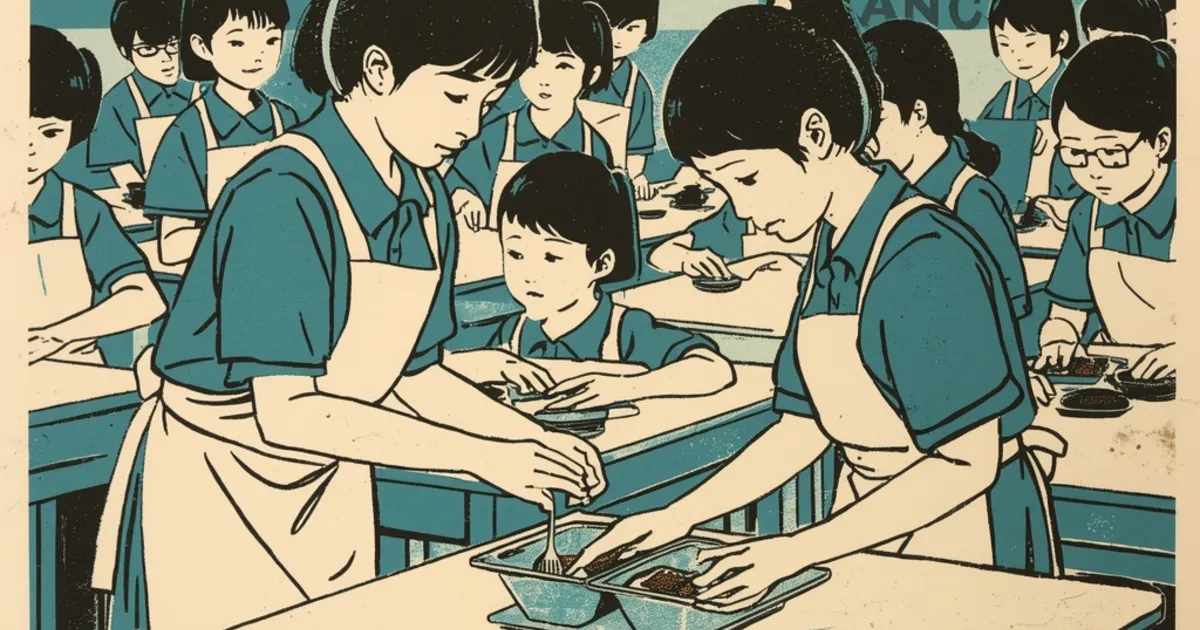
The Japanese word is kyūshoku, school meal. At noon a group of students puts on
white coats and caps, collects the food, and serves their classmates. Everyone eats in their
own classroom, not a cafeteria. Afterwards the children clear up themselves, instead of
leaving it to cleaners (Wikipedia, 2026a; Japan National Tourism Organization, n.d.).
There is no menu to choose from. Every child in a school gets the same meal (Asakura &
Sasaki, 2017). It's cooked from scratch at the school or at a nearby central kitchen, under
the supervision of dietitians, to national nutrition standards that set the energy, protein,
fat, calcium, iron and vitamins in each lunch (Miyawaki et al., 2019).
Almost every child gets one. In 2021, 99% of Japan's elementary schools and 91% of its
middle schools served school lunch (Wikipedia, 2026a).
Lunch is written into the law as a lesson
Japan's School Lunch Act dates from 1954. Under it, school lunch is an integral part of
education, "not simply an interval between classes or relaxation or break time", as two
Japanese nutrition researchers put it (Asakura & Sasaki, 2017).
In 2005 Japan went further and passed the Basic Act on Shokuiku, food education.
It defines shokuiku as knowing about food and nutrition, and learning through practice to
make good choices, so that people can live on a healthy diet (Wikipedia, 2026b). The Act
calls food education "the basis of a human life which is fundamental to intellectual
education, moral education, and physical education" (Wikipedia, 2026a).
That's the cultural insight. A child who serves the class learns that someone else's meal
depends on them. A child who wipes the table learns that the room is shared. Nobody at the
table is the customer, and nobody is the servant. Every school day, for up to nine years, the children
practise caring for a group.
It started as care, too. The first school meals in Japan were served in 1889 at an
elementary school in what is now Tsuruoka, free, for children who couldn't bring food from
home (Wikipedia, 2026a).
What it costs families
Parents pay a monthly fee. In 2014 it averaged about 4,300 yen (US$39) a month in public
elementary schools and 4,882 yen (US$44) in public junior high schools. Low-income families
can get help with it from local or national government (Asakura & Sasaki, 2017). Japan's
tourism office reports similar figures today: 4,343 yen and 4,941 yen a month (Japan National
Tourism Organization, n.d.).
Does it keep children healthy?
Japan's rate of childhood overweight and obesity has stayed low for decades, and has
fallen further in recent years, unlike in most other countries (Miyawaki et al., 2019). School lunch is part of the
reason.
Researchers at the University of Tokyo used nationwide data from 2006 to 2015, and
compared prefectures where more or fewer junior high students got school lunch. When
lunch coverage rose by 10 percentage points, the share of boys who were overweight fell by
0.37 points the following year, and the share who were obese by 0.23 points. For girls there
was no clear effect (Miyawaki et al., 2019).
The lunch also evens things out. In a Tokyo-area study of 719 children aged 6 to 12,
children of mothers with less education ate fewer vegetables overall. But at school lunch,
every child ate the same fruit and vegetables regardless of family income, and that closed
part of the gap (Yamaguchi et al., 2018). Because every child gets the same meal, no child is
marked out as the poor kid on free lunch.
It isn't perfect. A study that weighed what children ate found school lunches improved
vitamin and mineral intake, but still gave too little fibre, and nearly every child ate too
much salt across the whole day (Asakura & Sasaki, 2017). And until the 1970s, some
teachers forced children to finish their plates, which is now widely criticised as a
violation of children's rights (Wikipedia, 2026a). The meal works best as an invitation, not
an order.
Australia: the lunchbox country
Australia has no national school lunch program. Most students bring a packed lunch from
home or buy from the school canteen (Smith et al., 2024b). When Tasmania began its trial, no nutrition guidelines
existed for planning school lunch menus in Australia (Galloway et al., 2024).
Then Tasmania tried it. In 2022 and 2023 the Tasmanian Government funded the School Lunch
Project, run by the not-for-profit School Food Matters. It gave free cooked lunches, one to
four days a week, to children from kindergarten to Grade 10 at 30 schools in the state's most
disadvantaged areas. Dietitians designed the menus, with help from chefs (Smith et al.,
2024b).
In 2022 alone it served 78,832 lunches to 1,678 students at six schools. Parents said 79% of
children ate the lunch every day it was offered, and 74% of parents valued their child trying
new foods. In group discussions, parents described children trying new foods and families
starting to eat meals together at home. And 93% said they'd pay for it in future, a median
of $3 a lunch (Smith et al., 2024a).
One finding shouldn't be misread. The lunches didn't measurably change attendance (Smith et
al., 2024b). That's not a failure. Lunch in Japan was never meant to get children through
the gate. It's there to feed them well and teach them to feed each other.
What you can do
- Ask your school whether it could join or copy a school lunch trial. The
Tasmanian menu guidelines are published, and their authors say other states can use them (Galloway et
al., 2024).
- Borrow the ritual at home. Let children serve the table and clear it.
The lesson is that the meal belongs to everyone.
- Eat together. The same meal, at the same table, at the same time. It's
the cheapest part of the Japanese system to copy.
Japan didn't get here because its children are different. It decided, in law, that lunch
is worth teaching. Tasmania has shown Australian children will eat it and Australian parents
will pay for it. Next time someone says a lunchbox is a family's private business, ask what
children learn when nobody ever serves them, and they never serve anyone.
Sources
- Asakura, K., & Sasaki, S. (2017). School lunches in Japan: Their contribution to
healthier nutrient intake among elementary-school and junior high-school children. Public
Health Nutrition, 20(9), 1523–1533. doi.org/10.1017/S1368980017000374
- Galloway, H., DePaoli, K., Smith, K. J., & Reardon, J. (2024). Beyond the lunchbox:
Menu development guidelines for the Tasmanian School Lunch Project. Health Promotion
Journal of Australia, 36(1), e871. doi.org/10.1002/hpja.871
- Japan National Tourism Organization. (n.d.). Lunch in Japanese schools. Japan
Educational Travel. education.jnto.go.jp
- Miyawaki, A., Lee, J. S., & Kobayashi, Y. (2019). Impact of the school lunch program
on overweight and obesity among junior high school students: A nationwide study in Japan.
Journal of Public Health, 41(2), 362–370. doi.org/10.1093/pubmed/fdy095
- Smith, K. J., Cleland, V., Chappell, K., Fraser, B., Sutton, K., Proudfoot, M., Dunbabin,
J., & Jose, K. (2024b). Are cooked nutritious school lunches associated with improved
attendance? Findings from the 2022–2023 Tasmanian School Lunch Project. Nutrients,
16(19), 3393. doi.org/10.3390/nu16193393
- Smith, K. J., Cleland, V., Dunbabin, J., Fraser, B., Reardon, J., Galloway, H., DePaoli,
K., Sutton, K., Proudfoot, M., & Jose, K. (2024a). Parents' perceptions of the Tasmanian
School Lunch Project: Interim findings. Proceedings of the Nutrition Society,
83(OCE1), E27. doi.org/10.1017/S0029665124000454
- Wikipedia. (2026a). School lunch in Japan. wikipedia.org
- Wikipedia. (2026b). Shokuiku. wikipedia.org
- Yamaguchi, M., Kondo, N., & Hashimoto, H. (2018). Universal school lunch programme
closes a socioeconomic gap in fruit and vegetable intakes among school children in Japan.
European Journal of Public Health, 28(4), 636–641. doi.org/10.1093/eurpub/cky041






.jpg)