Only 5 to 10% of cancers come from the genes we inherit. The rest start with
something around us or something we do, which is where the claim that cancer is 90%
preventable comes from. With what we know today, the World Health Organization puts the share
we could actually prevent at 30 to 50%. The gap between those numbers is the interesting part,
and it keeps shrinking.
Nobody in this article is to blame for their cancer. "Preventable" is a
statement about populations and systems, never about one person. Plenty of people who did
everything right still get cancer, and plenty who didn't never do.
The 90% idea
In 2008 a team of cancer researchers reviewed decades of
research and put it plainly: "Only 5–10% of all cancer cases can be attributed to genetic
defects, whereas the remaining 90–95% have their roots in the environment and lifestyle"
(Anand et al., 2008). Their breakdown of cancer deaths:
| Cause | Share of cancer deaths |
|---|
| Tobacco | 25–30% |
| Diet | up to 30–35% |
| Infections | 15–20% |
| Other: radiation, stress, inactivity, pollution | the rest |
The paper's title says it all: Cancer is a preventable disease that requires major
lifestyle changes. The logic is simple. If inherited genes explain one case in ten or
twenty, then most cancer starts with something outside the body's own code, and what starts
outside can, in principle, be changed.
A second line of evidence backs the direction. In 2016 another team modelled lifetime cancer risk and concluded that factors inside the body contribute "only
modestly (less than ~10–30% of lifetime risk)". The rest comes from outside (Wu et al.,
2016). So the 90% idea isn't a fringe claim. It's what you get when you ask "what share of
cancer is not written into us from birth?"
What the health agencies say
Health agencies ask a narrower question: how much could we prevent today, using only causes
proven beyond doubt and interventions that already exist?
- World Health Organization: "Between 30% and 50% of cancer deaths could be
prevented by modifying or avoiding key risk factors and implementing existing evidence-based
prevention strategies." Its 2026 fact sheet puts the share of cancers preventable now at about
38% (WHO, 2026a, 2026b).
- Australia: Australian researchers counted 20 proven causes, from
smoking to sunburn to seven infections. About 38% of Australian cancer deaths and 33% of cancer
cases traced back to them: roughly 16,700 deaths and 41,200 cases a year (Wilson et al.,
2018). Smoking alone accounted for 23% of cancer deaths.
- Cancer Council Australia says a cancer-smart lifestyle could prevent "at
least one in three cases" (Cancer Council Australia, 2026).
Why the numbers differ so much
Nobody here is getting the maths wrong. They're answering different questions.
- "Not inherited" is bigger than "preventable today". The 90% figure counts
everything that isn't in the genes. The 30 to 50% counts only causes we've proven and can act
on. Air, water, food chemistry and ageing sit in the first number but mostly not the second.
- Only known causes get counted. The Australian study measured 20 factors.
A cause nobody has pinned down yet adds nothing to the estimate. As research finds more
causes, the preventable share rises. That's why today's figure is a floor.
- Deaths versus cases. Smoking causes some of the deadliest cancers, so the
preventable share of deaths (38% in Australia) runs higher than the share of cases (33%).
- Proven versus plausible. Diet sits at 30 to 35% in the 2008 review and
about 5% in the Australian study, which counted only four dietary factors with firm evidence.
The truth probably lies between, and the evidence is still coming in.
The "bad luck" debate
In 2015 two researchers, Cristian Tomasetti and Bert Vogelstein, published
a finding that made headlines around the world. Tissues whose cells divide more often get
cancer more often, and the link was strong. They wrote that most of the variation in cancer
risk between tissues "is due to 'bad luck,' that is, random mutations arising during DNA
replication" (Tomasetti & Vogelstein, 2015).
Headlines turned that into "most cancer is bad luck". The paper said something narrower: it
compared tissues, such as bowel against brain, not people. Critics, including the team
above, answered that the pattern can't separate luck from exposure (Wu et al., 2016).
In 2017 the same team returned with data from 69 countries. They estimated
that copying errors cause about two-thirds of the mutations in human cancers, and
they said this was "consistent with epidemiological estimates of the fraction of cancers that
can be prevented" (Tomasetti et al., 2017). Both things can be true: chance plays a real part, and a
large share of cancer can still be stopped.
The bad-luck research carries a kind message. People who get cancer despite never smoking,
eating well and staying active didn't fail. Their cells made a copying error, as all cells do.
That's also why it points to a second tool alongside prevention: finding cancer early.
What Australia has already prevented
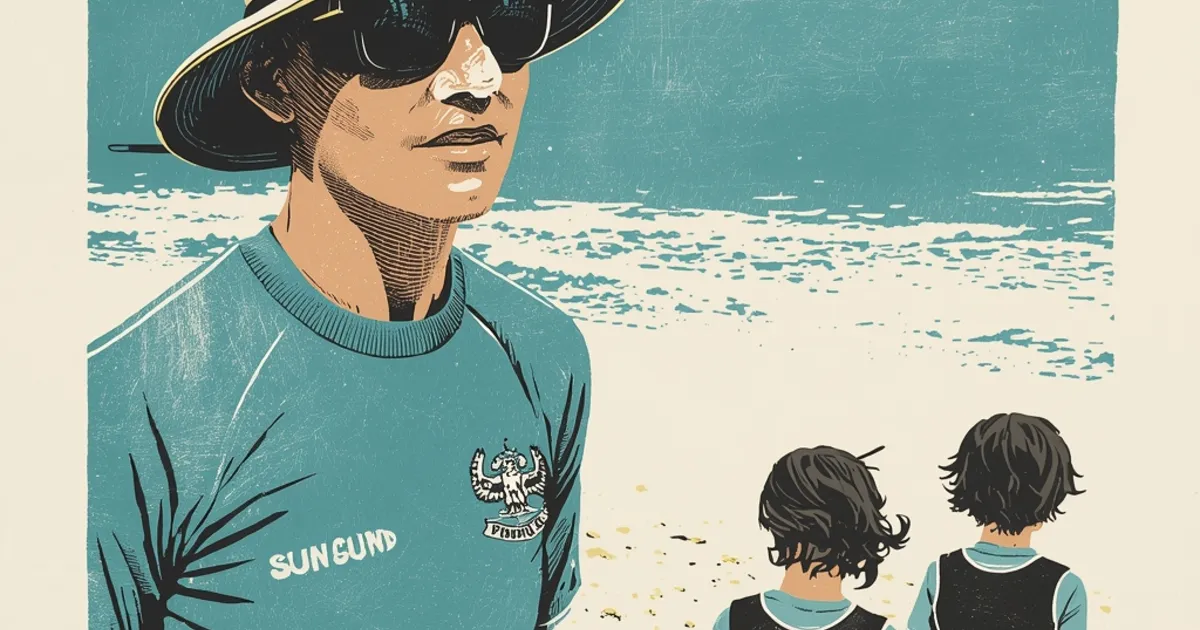
Slip, Slop, Slap. In 1981 Cancer Council Victoria, funded by public
donations, put an animated seagull called Sid on television singing three instructions: slip
on a shirt, slop on sunscreen, slap on a hat. A generation of Australian children grew up
singing it. In 2010 "seek" shade and "slide" on sunglasses were added (Wikipedia, 2026a).
The generation that grew up with Sid now has less melanoma. The rate of melanoma diagnosed
by age 30 peaked in 1997 and halved by 2020, according to Australian Institute of Health and
Welfare data (Wikipedia, 2026a). The rise in melanoma is now concentrated in people over 60,
who spent most of their lives in the sun before the message arrived. A campaign isn't the only
thing that changed in those years, but the young people who heard it are the ones whose rates
fell.
A vaccine made here. Ian Frazer and Jian Zhou at the University of
Queensland developed the technology behind the HPV vaccine. In 2007 Australia became the first
country to fund HPV vaccination for all girls, and it added boys in 2013. Among women aged 18
to 24, the vaccine-targeted HPV types fell from 28.7% of screening samples to 6.7% (Wikipedia,
2026b). With vaccination and screening together, Australia is on track to eliminate cervical
cancer as a public health problem, defined as fewer than four new cases per 100,000 women a
year (Wikipedia, 2026c).
Neither story asked anyone to try harder on their own. Each made the safe choice the easy
one, for everyone at once. That's what prevention at scale looks like.
What you can do or check
- Check vaccination. HPV and hepatitis B vaccines both prevent infections
that cause cancer.
- Keep up with screening. Cervical and bowel screening find cancer early,
or before it starts.
- Look at the biggest lever first. Smoking accounts for more preventable
cancer deaths in Australia than any other cause. Quit support is a system job as much as a personal one.
- Ask for shade. At your school, sports club or workplace, a shade sail
protects everyone who stands under it.
Is cancer 90% preventable? In the sense that 90% isn't inherited, the research supports it.
In the sense of what we can prevent tomorrow morning, the answer is about a third to a half.
The gap between the two numbers is the research still to be done, and every cause found
moves cancer from the "bad luck" column to the "preventable" one.
Sources
- Anand, P., Kunnumakara, A. B., Sundaram, C., Harikumar, K. B., Tharakan, S. T., Lai, O. S.,
Sung, B., & Aggarwal, B. B. (2008). Cancer is a preventable disease that requires major
lifestyle changes. Pharmaceutical Research, 25(9), 2097–2116.
doi.org/10.1007/s11095-008-9661-9
- Cancer Council Australia. (2026). Causes and prevention.
cancer.org.au
- Tomasetti, C., & Vogelstein, B. (2015). Variation in cancer risk among tissues can be
explained by the number of stem cell divisions. Science, 347(6217), 78–81.
doi.org/10.1126/science.1260825
- Tomasetti, C., Li, L., & Vogelstein, B. (2017). Stem cell divisions, somatic mutations,
cancer etiology, and cancer prevention. Science, 355(6331), 1330–1334.
doi.org/10.1126/science.aaf9011
- Wikipedia. (2026a). Slip-Slop-Slap.
wikipedia.org
- Wikipedia. (2026b). HPV vaccine.
wikipedia.org
- Wikipedia. (2026c). Cervical cancer.
wikipedia.org
- Wilson, L. F., Antonsson, A., Green, A. C., Jordan, S. J., Kendall, B. J., Nagle, C. M.,
Neale, R. E., Olsen, C. M., Webb, P. M., & Whiteman, D. C. (2018). How many cancer cases and
deaths are potentially preventable? Estimates for Australia in 2013. International Journal
of Cancer, 142(4), 691–701.
doi.org/10.1002/ijc.31088
- World Health Organization. (2026a). Cancer (health topic).
who.int
- World Health Organization. (2026b). Cancer (fact sheet).
who.int
- Wu, S., Powers, S., Zhu, W., & Hannun, Y. A. (2016). Substantial contribution of
extrinsic risk factors to cancer development. Nature, 529(7584), 43–47.
doi.org/10.1038/nature16166

,_Mo_i_Rana,_Norway_2017-10-09_a.jpg)


