Since 1987 Australia's workforce has doubled. The jobs that manage, coordinate and
administer other people's work have grown about four times over. The secretaries who once did the
paperwork have more than halved, so now everyone does it. It's not that we have more bosses as a
share of workers. It's that more of the work is about the work.
What the ABS counts
Every quarter the Australian Bureau of Statistics counts employed people by the kind of work
they do. The series runs back to August 1986, with the older years coded to the same 2013
occupation groups used today, so a job in 1987 and a job in 2025 land in the same box (ABS,
2026a; ABS, 2026b).
Start with the big groups, as a share of everyone employed:
| Occupation group | Aug 1987 | Aug 2025 |
|---|
| Managers | 12.5% | 12.9% |
| Clerical and administrative workers | 17.9% | 12.5% |
| Professionals | 15.7% | 27.7% |
| Community and personal service workers | 5.6% | 11.9% |
| Technicians and trades workers | 17.8% | 13.6% |
| Labourers | 13.5% | 8.1% |
(ABS, 2026a. Employed persons, original series; 7.09 million people in 1987, 14.52 million in
2025.)
On these numbers the country isn't top-heavy. About one worker in eight was a manager then,
and about one in eight is now. Clerks fell. Carers and other personal service workers doubled
their share.
Look one level down
The big group called "Managers" hides a swap. The ABS splits it, and the other groups, into
smaller ones:
| Job group | Aug 1987 | Aug 2025 | Change |
|---|
| All employed people | 7,092,000 | 14,517,000 | 2.0 times |
| Chief executives, general managers and legislators | 42,000 | 131,000 | 3.1 times |
| Specialist managers | 268,000 | 1,023,000 | 3.8 times |
| Office managers and program administrators | 76,000 | 311,000 | 4.1 times |
| Business, human resource and marketing professionals | 206,000 | 913,000 | 4.4 times |
| Personal assistants and secretaries | 178,000 | 79,000 | 0.4 times |
| Farmers and farm managers | 249,000 | 156,000 | 0.6 times |
| Factory process workers | 233,000 | 158,000 | 0.7 times |
| Construction trades workers | 257,000 | 404,000 | 1.6 times |
| Carers and aides | 118,000 | 802,000 | 6.8 times |
(ABS, 2026b. Full-time plus part-time, rounded to the nearest thousand.)
The workforce doubled. The people who run programs, manage specialist functions and handle
staff grew about twice as fast as that. The people who used to type, file and keep diaries for
others fell by more than half. Farmers, who manage by working the land, shrank too.
Some of that is good news. Carers and aides grew almost sevenfold, and health professionals
nearly fourfold, as Australia chose to look after more people. But look at who replaced the
secretaries. Nobody did. A generation ago one person wrote up the minutes, booked the room and
filed the form. Now the manager, the nurse and the teacher each do their own.
Where the frontline's time goes
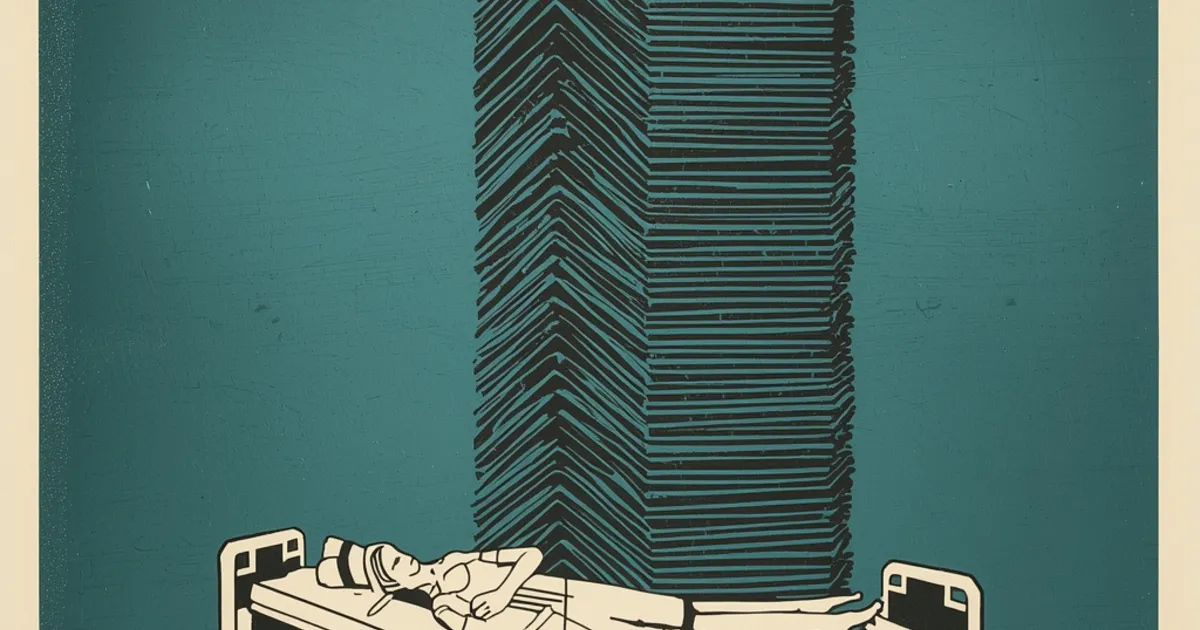
You can see it on a hospital ward. In a Sydney teaching hospital, researchers followed 57
nurses for 191 hours between 2005 and 2008. Nurses spent about 37% of their time with patients,
and it didn't rise over the study. They switched tasks every 55 seconds (Westbrook et al., 2011).
The same team followed 19 doctors on the wards of a 400-bed Sydney hospital in 2006. The
newest doctors, the interns, spent 22% of their time on documentation, "almost double the time
they were engaged in direct patient care" (Westbrook et al., 2008).
Schools tell the same story. The Australian Council for Educational Research, which runs the
OECD's international teacher survey here, named administrative workload among teachers' main
sources of stress in the 2024 results, and found that general administration was linked to lower
wellbeing (ACER, 2025).
None of these people are doing anything wrong. The system hands them the forms. How much of a
working week that takes, and how to give the hours back, is the subject of
Why aren't we working 15 hours a week?
Why organisations grow the top
In 1955 the naval historian C. Northcote Parkinson wrote a joke essay for The Economist
that turned out not to be a joke. The British Admiralty kept growing while the Navy had fewer
ships. The Colonial Office had the most staff when there were hardly any colonies left. Parkinson
gave two reasons: "An official wants to multiply subordinates, not rivals", and "Officials make
work for each other." By his count, the staff of a bureaucracy grew 5 to 7% a year "irrespective
of any variation in the amount of work (if any) to be done" (Wikipedia, 2026a).
Sixty years later the management researchers Gary Hamel and Michele Zanini ran the numbers for
the United States. In 2014 it had 23.8 million managers, supervisors and administrators, one for
every 4.7 employees. They made up 17.6% of the workforce and took nearly 30% of the pay. Hamel and
Zanini put the cost of excess bureaucracy at "more than $3 trillion in lost economic output, or
about 17% of GDP" (Hamel & Zanini, 2016). Their count includes frontline supervisors, so it
isn't directly comparable with the ABS table. They expanded the argument in the 2020 book
Humanocracy (Hamel & Zanini, 2020).
Their best example: General Electric's jet engine plant in Durham, North Carolina. More than 300
technicians, one supervisor, and more than twice as productive as its sister plants (Hamel &
Zanini, 2016).
"If we did that, I wouldn't have a job"
A worker in a state justice department once found a faster way to get a routine job done and
took it to her manager. The answer: "If we did that efficient method, I wouldn't have a job."
The manager wasn't lazy or wicked. The manager was right. In most organisations a manager's pay,
title and safety grow with the size of the team and the budget, and shrink when the work gets
simpler. Parkinson saw it in 1955: nobody inside is paid to make their own role unnecessary. Every
layer has a reason to keep the layer below it busy, and the paperwork is how busy is proved.
That's a design problem, not a character flaw. Change what people are rewarded for, and the same
people will cut the work instead of guarding it.
The places that took the layers out
Morning Star, in California, processes about 40% of the state's processing
tomatoes. It has about 550 full-time staff and more than 2,500 seasonal workers at harvest, and no
supervisory managers. Workers write their own job responsibilities, can buy equipment after
consulting experts, and are paid on the basis of reviews from their peers (Wikipedia, 2026b).
W. L. Gore, the maker of Gore-Tex, has worked this way since Bill Gore
described a "lattice" organisation to staff in 1967. Everyone holds the same title, associate.
There's no chain of command; people choose which leaders to follow, and leaders emerge as they
gain followers. Gore was on Fortune's list of the 100 best US companies to work for every
year from 1984 to 2017 (Wikipedia, 2026c).
Haier, the Chinese appliance maker, was a near-bankrupt Qingdao fridge factory
when Zhang Ruimin took it over in 1984. After a customer complaint, Zhang had workers smash 76
faulty fridges with sledgehammers to make the point about quality. Later Haier split its workforce
into hundreds of internal micro companies, each with its own profit and loss account, and Zhang
built that into a management model called rendanheyi (Wikipedia, 2026d).
Flat isn't magic
It fails too. Valve, the games company, has no bosses outside its executives, yet some
staff hold more sway through seniority or relationships, and a 2023 investigation linked
its structure to a poor release record and a lack of diversity. Its co-founder Gabe Newell has
said "there are plenty of great developers for whom this is a terrible place to work"
(Wikipedia, 2026e).
When Zappos moved to a self-management system called Holacracy, about 14% of staff left in
2015, as the company deliberately kept only people who believed in it. The publisher Medium dropped the same system in 2016. One
critic argued its rules focused on "administrivia" (Wikipedia, 2026f). A flat chart can grow its
own paperwork. The layers matter less than whether the rules serve the work.
The tall poppy question
Australians describe themselves as egalitarian. "Tall poppy syndrome", the habit of cutting
down people who stand out, is a term that grew up in Australia and New Zealand and has been
described as a by-product of that egalitarian value (Wikipedia, 2026g).
So here's the question. A country that distrusts anyone who gets above themselves has built
workplaces where the fastest-growing jobs manage, coordinate and report on other people's work.
Why does the tall poppy rule stop at the org chart?
Count the admin in your own week
- Tally one week. Mark each hour as doing the work, or writing about the
work. Include email, approvals, reports and meetings about meetings.
- Name who reads it. For each report or form, write down who uses it and what
they do with it. If nobody can answer, that's the first one to question.
- Count the layers. How many people must say yes before you can spend $500 or
fix a small problem? At GE Durham the answer was one.
Most of this work isn't anyone's fault. It's a rule nobody has had time to remove, and rules
can be removed. Morning Star, Gore and a jet engine plant in North Carolina show the work still
gets done.
Sources
- Australian Bureau of Statistics. (2026a). Table 07. Employed persons by occupation major group
of main job (ANZSCO) and sex. In Labour force, Australia, detailed, March 2026.
abs.gov.au
- Australian Bureau of Statistics. (2026b). EQ07a. Employed persons by age, occupation sub-major
group of main job (ANZSCO) and sex, August 1986 onwards. In Labour force, Australia, detailed,
March 2026.
abs.gov.au
- Westbrook, J. I., Duffield, C., Li, L., & Creswick, N. J. (2011). How much time do nurses
have for patients? A longitudinal study quantifying hospital nurses' patterns of task time
distribution and interactions with health professionals. BMC Health Services Research,
11, 319. doi.org/10.1186/1472-6963-11-319
- Westbrook, J. I., Ampt, A., Kearney, L., & Rob, M. I. (2008). All in a day's work: An
observational study to quantify how and with whom doctors on hospital wards spend their time.
Medical Journal of Australia, 188(9), 506–509.
doi.org/10.5694/j.1326-5377.2008.tb01762.x
- Australian Council for Educational Research. (2025). TALIS reveals insights into teacher
wellbeing, job satisfaction and future opportunities.
acer.org
- Hamel, G., & Zanini, M. (2016, September 5). Excess management is costing the U.S. $3
trillion per year. Harvard Business Review.
hbr.org
- Hamel, G., & Zanini, M. (2020). Humanocracy: Creating organizations as amazing as the
people inside them. Harvard Business Review Press.
- Wikipedia. (2026a). Parkinson's law. wikipedia.org
- Wikipedia. (2026b). The Morning Star Company. wikipedia.org
- Wikipedia. (2026c). W. L. Gore & Associates. wikipedia.org
- Wikipedia. (2026d). Zhang Ruimin; Haier. wikipedia.org
- Wikipedia. (2026e). Valve Corporation. wikipedia.org
- Wikipedia. (2026f). Holacracy. wikipedia.org
- Wikipedia. (2026g). Tall poppy syndrome. wikipedia.org