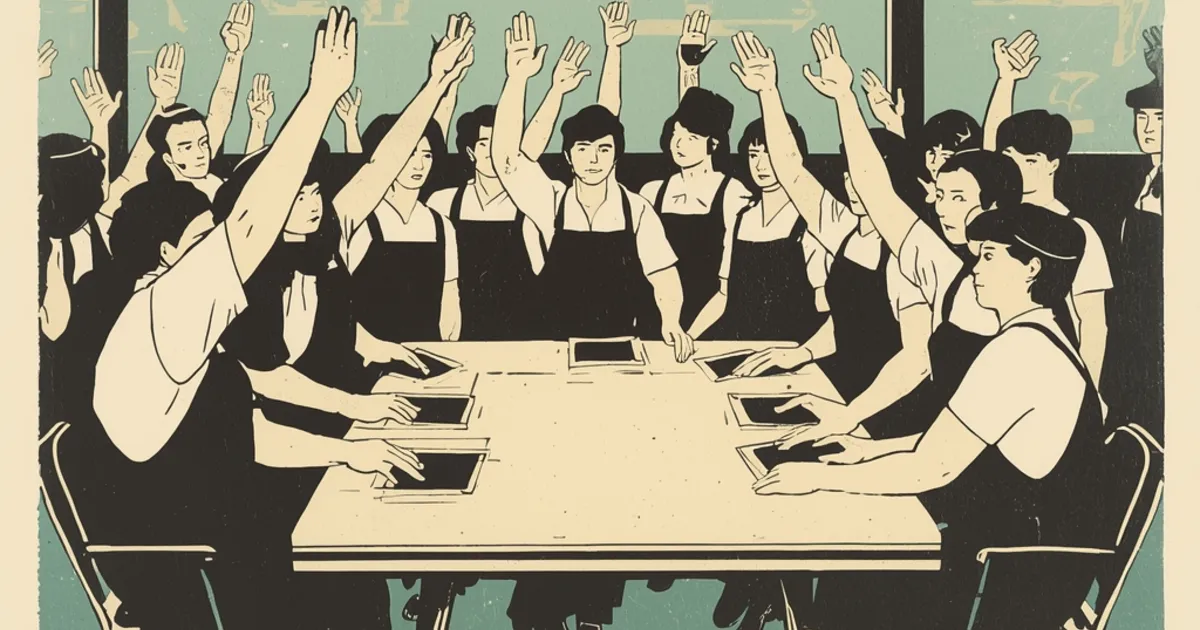
Because the law says so. Since 1976, in any German company with more than 2,000
staff, the workers elect half the supervisory board. From 500 staff they elect a third. The
Germans call it Mitbestimmung: deciding together. The best evidence says it costs
the owners nothing, and when a crisis hits, it helps keep people in their jobs.
How it works
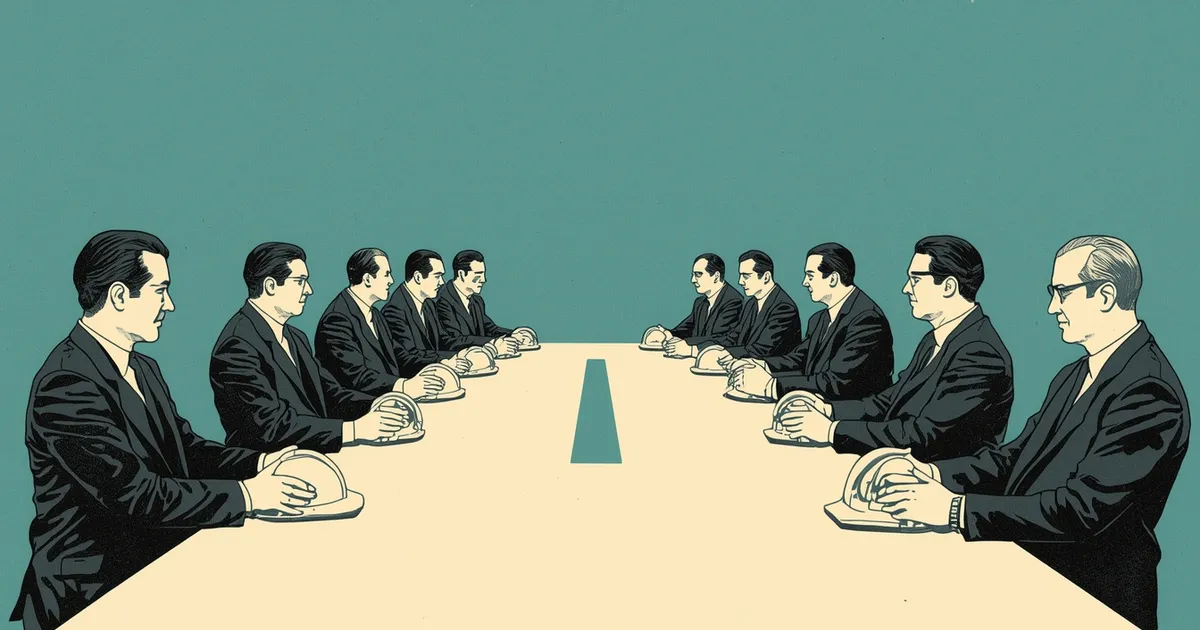
A large German company has two boards. The management board runs the business day to day.
The supervisory board above it appoints and oversees the managers. That's where the workers
sit.
| Company size | Workers elect | Law |
|---|
| Coal, mining and steel, over 1,000 staff | Half, with a neutral extra member | 1951 |
| Over 2,000 staff | Half the seats | 1976 |
| 500 to 1,999 staff | One third | 2004 (first set in 1952) |
(Wikipedia, 2026a; Wikipedia, 2026b)
Half isn't quite equal. Outside coal and steel, the shareholders pick the chair, and the
chair has a casting vote to break a tie (Wikipedia, 2026a). The owners keep the last word.
The workers get a full hearing before it's said.
A council in every workplace
The board is the top layer. The layer that touches daily life is the works council, the
Betriebsrat. Any workplace with five or more permanent staff can elect one
(Works Constitution Act, s 1). The council doesn't just get consulted. On some questions the
boss can't act without it, including when the working day starts and ends, and any
"temporary reduction or extension" of normal hours (Works Constitution Act, s 87).
That last right matters more than it sounds. It means a cut to everyone's hours is
something the staff agree to, not something done to them.
2009: cut the hours, not the people
When the global financial crisis hit, German factories lost orders overnight. Many firms
didn't sack anyone. They used Kurzarbeit, short-time work: everyone works fewer
hours, the company pays for the hours worked, and the Federal Employment Agency pays 60% of
the pay for the hours lost. A 30% cut in hours costs a worker only about 10% of their income
(Wikipedia, 2026c).
In 2009 more than 1.4 million German workers were on it, at a cost of 5.1 billion euros.
An OECD report found it saved nearly 500,000 jobs during the recession. The IMF calls it
"widely considered the gold standard" of such programs (Wikipedia, 2026c).
The idea is old. Germany first used it in 1910, for the potash industry. But it works best
where the people on the shop floor and the people at the top already talk. A works council
that must agree to shorter hours, and worker directors who sit with the managers, turn "who
do we let go?" into "how do we all get through this?".
When orders came back, the trained staff were still there. Firms didn't need to hire and
train from scratch. Shorter hours shared by everyone look a lot like the four-day week idea,
covered in Do shorter working weeks work?
Does it cost the owners?
The old fear: give workers seats, and they'll vote themselves pay rises and scare off
investment. Economists Simon Jäger, Benjamin Schoefer and Jörg Heining tested it. In 1994
Germany dropped the one-third rule for new companies, but kept it for companies formed
before August that year. Two groups of near-identical firms, one with worker directors and
one without.
They found no effect on wages or the share of income that went to workers. And no flight
of capital. Shared governance, they wrote, "if anything, increases capital formation"
(Jäger et al., 2021). Firms with workers on the board invested at least as much.
That cuts both ways, and it's worth saying plainly. One-third of the seats didn't make
workers richer. What it changes is who's in the room: how decisions get made, not how much
is paid.
Why Germany?
The roots go back to November 1918. The war was lost and the country was in revolution.
The industrialist Hugo Stinnes and the union leader Carl Legien, from opposite sides of
everything, signed a deal. Employers recognised unions and their right to bargain, workers
got the eight-hour day, firms of more than 50 staff got workers' councils, and returning
soldiers got the right to their old jobs back (Wikipedia, 2026d).
After the Second World War the question came back harder. Heavy industry, coal and steel
above all, had an economic interest in the war (Wikipedia, 2026e). Giving the workers half
the seats in those firms, by law in 1951, put a check on that power. It passed after the
metalworkers' unions threatened mass strikes (Wikipedia, 2026b).
The rebuilt West Germany called itself a "social market economy", a term coined in
December 1946. Markets, yes, but with "secure social peace" as a condition of the economic
miracle, not a nice extra (Wikipedia, 2026f).
Germans call unions and employers Sozialpartner: social partners. Not everyone
likes the word. Critics call it a euphemism and prefer "antagonistic cooperation" or
"conflict partnership" (Wikipedia, 2026g). That's the real insight. Nobody pretends bosses
and staff want the same things. The system assumes they don't, and builds a table where
they have to settle it anyway.
The limits
- The owners still decide. The shareholders' chair breaks every tie.
- Few companies are big enough. In 2005 the half-the-board law covered
729 companies, and the coal and steel law about 30 (Wikipedia, 2026a).
- Works councils are patchy. In 2019, depending on the industry, between
16% and 86% of employees worked somewhere with one (Wikipedia, 2026h).
- It doesn't raise pay on its own. The best study finds no wage effect.
- The evidence isn't settled. Some economists find long-run productivity
gains; others argue efficiency losses outweigh them (Wikipedia, 2026a).
And Australia?
Australia has no such law. "Australia has not yet passed a general federal law, like a
majority of wealthier OECD countries, to protect the right to vote for directors at work"
(Wikipedia, 2026i). There are a few exceptions in public bodies, and nothing across private
companies.
The other channels have thinned out too. Union membership was about 15% in 2024, down
from close to 60% in 1962. Enterprise agreements covered 15% of workers in 2021 (Wikipedia,
2026i). Most Australian workers have no vote on the board and no council with a say over
their hours.
Now picture going further than Germany. Worker directors in every company with more than
50 staff, not just the giants. The owners keep their capital and their casting vote. The
people who do the work get seats at the table where the work is decided. On the German
evidence, the owners lose nothing measurable. In the next downturn, the first question in
the boardroom would be how to keep everyone, and someone in the room would be there to ask
it.
What you can check
- Ask whether your workplace has a staff-elected director, or any worker voice on the
board. In most Australian companies the answer is no.
- When layoffs are announced, ask whether shorter hours for everyone were on the table
first, and who decided.
- Look at who sits on the board of a company you buy from, bank with or work for. Count
the people elected by the staff.