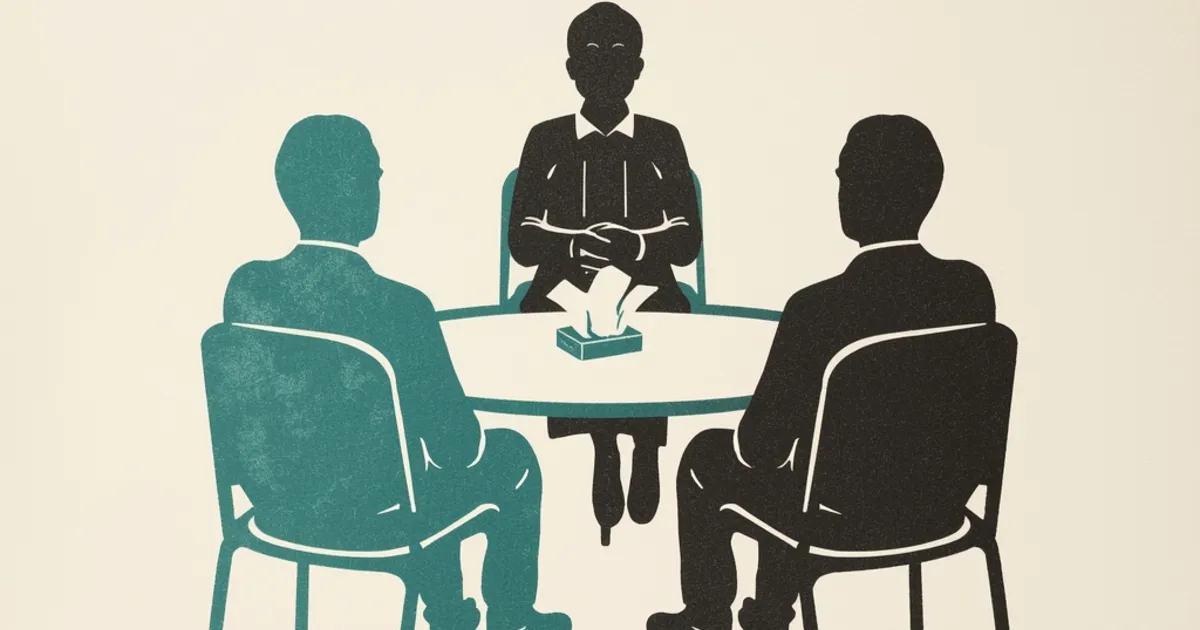
When the person harmed and the person who did it sit down together, with their
families and a trained facilitator, victims come away more satisfied, less afraid and less
set on revenge, and offenders commit less crime afterwards than people sent through court
alone. New Zealand has run its youth justice this way since 1989. The question is why the
rest of justice doesn't.
This is an idea as well as a record. It asks what justice would look like
if every serious case started with a meeting instead of a trial, and then checks what the
meetings already in use have shown.
The idea
A court asks one question: who is guilty, and what do they deserve? The person harmed
mostly watches. They may give evidence, be cross-examined and read a statement, but the case
belongs to the state.
A restorative meeting asks different questions. What happened? Who was hurt, and how? What
needs to happen to put it right? The people who answer are the ones who lived it: the person
harmed, the person responsible, and the families around both.
Take that seriously and run it all the way through the system:
- Meet before anyone is sent to prison. No sentence of imprisonment until
the person harmed has been offered a face-to-face meeting.
- Let the people involved write the plan. Repair, apology, work, treatment,
whatever the person harmed needs and the person responsible can actually do.
- Keep the court for what a meeting can't settle. A denial, a refusal, a
danger that needs containing.
The measure of success changes too. Not how much the offender suffered, but whether the
person harmed can sleep again, and whether anyone else gets hurt.
New Zealand already does it for children
In the 1980s, Māori were alarmed at how many of their children were in state care and the
youth justice system (Wikipedia, 2026a). In 1986 a ministerial committee on a Māori
perspective for the Department of Social Welfare produced Pūao-te-Āta-tū, a report on
racism within society and inside the department itself (Wikipedia, 2026b).
Parliament answered with the Children, Young Persons, and Their Families Act 1989. It made
arrest and imprisonment for young people a last resort and introduced the family group
conference: a way to decide what happens to a child "that did not involve a Court Hearing"
(Wikipedia, 2026c).
Who comes: the young person and their whānau (extended family), the victim and their
supporters, police, a youth justice coordinator, and others who can help, such as teachers or
health workers. If the young person disputes what police say happened, the conference ends and
police or the court take over. If everyone agrees on a plan, it becomes legally binding and
must be completed (Oranga Tamariki, n.d.).
The cultural insight
The conference is built to reflect Māori custom: decisions made together by everyone
affected (Wikipedia, 2026a). One step shows it best. Partway through, the professionals leave
the room. The whānau and the young person take time alone to work out a clear, realistic plan,
then bring it back to the group (Oranga Tamariki, n.d.).
That's the reverse of a courtroom. In court, strangers decide and the family waits outside.
In a conference, the family is trusted to hold its own child to account, because it knows the
child, and it will still be there when the officials have gone home.
Australia picked it up
In 1991 an Australian police officer, Terry O'Connell, adapted the family group
conference to divert young people from court into a restorative meeting (Wikipedia, 2026d).
New South Wales wrote youth justice conferencing into law in the Young Offenders Act 1997
(Wikipedia, 2026e).
Canberra went further and tested it properly. From 1995 to 2000, the Reintegrative Shaming
Experiments (RISE) randomly sent people arrested for property crime, shoplifting, violence or
drink driving either to court or to a conference. Observers found offenders significantly more engaged in
conferences, and treated more ethically, than in court (Barnes et al., 2013). Random assignment
matters: the people in each group were alike, so differences in how they fared come from the
process, not from who was chosen.
What the evidence says
Heather Strang, Lawrence Sherman and colleagues pooled every randomised trial of face-to-face
conferencing they could find for the Campbell Collaboration: 10 trials, 1,879 offenders and 734
interviewed victims (Strang et al., 2013).
| Compared with court alone | Conference plus the usual process |
|---|
| Repeat offending | Significantly lower, with bigger effects for violent crime than
property crime |
| Victims' satisfaction with how the case was handled | Higher |
| Apology | Victims more likely to receive one, and to believe it was sincere |
| Desire for revenge | Lower |
| Post-traumatic stress symptoms | Fewer |
| Cost | In the seven UK trials, crime prevented was worth about eight times what the
conferences cost |
The finding on violence runs against instinct. Many people assume meetings suit minor
matters and serious harm needs a courtroom. The trials suggest the opposite: the more a crime
hurt someone, the more a meeting achieved.
Prison, by contrast, sends people home carrying more harm than they went in with, as
It wasn't that bad? What prison does to people after
release sets out.
The limits
A fair account needs these too.
- It needs an admission. A conference starts from what happened, not whether
it happened. Where someone denies the offence, a court or something like it still has to decide
(Oranga Tamariki, n.d.).
- Victims choose. The trial victims agreed to take part. Nobody should be made
to sit across from the person who hurt them.
- Not every study agrees. A 2002 review of victims' experiences found no
evidence they were more satisfied than with ordinary justice (Wikipedia, 2026e). Others report
apologies that ring hollow and little mutual understanding, especially with young offenders
whose thinking is still developing (Suzuki & Wood, 2017).
- Family can be the problem. New Zealand's model leans on whānau. Where a
family is itself chaotic or harmful, critics say the young person can be underserved
(Wikipedia, 2026a).
- Rights. Critics such as Allison Morris list the fears: that it erodes legal
rights, draws more people into the system, or trivialises crime (Wikipedia, 2026e).
None of these says "keep courts as they are". They say keep a fair way to settle denials,
protect people who say no, and support families that can't carry the weight alone.
A real story
On 12 October 1984 an IRA bomb aimed at Prime Minister Margaret Thatcher and her cabinet
exploded in a hotel in Brighton, England. It killed five people. One was Sir Anthony Berry, a member of
Parliament (Wikipedia, 2026f).
Patrick Magee planted the bomb, received eight life sentences and was released in 1999,
after 14 years, under the Good Friday Agreement (Wikipedia, 2026g). In November 2000 Sir
Anthony's daughter, Jo Berry, met Magee, having asked for the meeting to understand the conflict
from the other side. They talked for three hours. Magee later reflected that "the goodness and
intelligence and value I perceived in this woman must in some measure have come from her
father. And I had killed him" (Wikipedia, 2026f).
Magee still defends taking part in the bombing, and has expressed remorse for the loss of
innocent lives (Wikipedia, 2026g). Berry didn't need Magee's agreement to keep talking. In
2009 Berry founded the charity Building Bridges for Peace, and the two have appeared together
more than 300 times, in places including Rwanda, Lebanon, Israel and Belfast (Wikipedia,
2026h). No court could have ordered that.
Why doesn't it exist for everyone?
The evidence is there, the model has run for over three decades, and it came from people
who knew their own communities. Yet for adults in Australia, meetings remain an add-on, offered
in some places, for some offences, if someone asks.
Part of the answer is what we think justice is for. If it's for making someone suffer,
a meeting looks soft. If it's for the person harmed and the next person who might be, the
trials say a meeting does the job better.
What you can do
- If you've been harmed, ask the police, the court or your state's victim
support service whether a restorative meeting is available. You can say no at any stage.
- Ask your MP whether adults in your state can be offered a conference
before a prison sentence, and if not, why not.
- Next time someone says a meeting is soft on crime, ask which result they
want: a harsher sentence, or fewer victims.
Sources
- Barnes, G. C., Hyatt, J. M., Angel, C. M., Strang, H., & Sherman, L. W. (2013). Are
restorative justice conferences more fair than criminal courts? Criminal Justice Policy
Review, 26(2), 103–130. doi.org/10.1177/0887403413512671
- Oranga Tamariki. (n.d.). Youth justice family group conferences. orangatamariki.govt.nz
- Strang, H., Sherman, L. W., Mayo-Wilson, E., Woods, D., & Ariel, B. (2013). Restorative
justice conferencing (RJC) using face-to-face meetings of offenders and victims. Campbell Systematic
Reviews, 9(1). doi.org/10.4073/csr.2013.12
- Suzuki, M., & Wood, W. R. (2017). Is restorative justice conferencing appropriate for
youth offenders? OSF Preprints. doi.org/10.31235/osf.io/3etxp
- Wikipedia. (2026a). Youth justice in New Zealand. wikipedia.org
- Wikipedia. (2026b). Pūao-te-Ata-tū. wikipedia.org
- Wikipedia. (2026c). Oranga Tamariki Act 1989. wikipedia.org
- Wikipedia. (2026d). Restorative practices. wikipedia.org
- Wikipedia. (2026e). Restorative justice. wikipedia.org
- Wikipedia. (2026f). Brighton hotel bombing. wikipedia.org
- Wikipedia. (2026g). Patrick Magee (Irish republican). wikipedia.org
- Wikipedia. (2026h). Jo Berry. wikipedia.org