Keynes expected us to work about 15 hours a week by now. The anthropologist
David Graeber argued that pointless jobs filled the gap. Later studies found far fewer people
call their own job useless, but the paperwork inside useful jobs keeps growing. Cut the work
that produces nothing, and the hours can come back as time.
The promise
In 1930, in the middle of the Great Depression, the economist John Maynard Keynes wrote an
essay called "Economic Possibilities for our Grandchildren". He predicted that "the standard
of life in progressive countries one hundred years hence will be between four and eight times
as high as it is to-day". With that much wealth, he wrote, the work left to do could be
shared: "Three-hour shifts or a fifteen-hour week may put off the problem for a great while"
(Keynes, 1930/1931).
The wealth arrived. The short week didn't. Australia's National Employment Standards still
set 38 hours as the ordinary full-time week (Wikipedia, 2026a).
Graeber's answer: we invented work
In 2013 the anthropologist David Graeber wrote a short
essay for a magazine called Strike!. "Huge swathes of people, in Europe and North
America in particular, spend their entire working lives performing tasks they secretly believe
do not really need to be performed" (Wikipedia, 2026b). It was read more than a million times
and translated into 12 languages.
Two years later the pollster YouGov asked British workers whether their job made a meaningful
contribution to the world. 37% said no (Wikipedia, 2026c).
In 2018 Graeber turned the essay into a book, Bullshit Jobs. He defined one as paid
work "so completely pointless, unnecessary, or pernicious that even the employee cannot justify
its existence", while the worker still feels obliged to pretend otherwise. He sorted them into
five kinds:
| Type | What the job does |
|---|
| Flunkies | Make someone else look or feel important |
| Goons | Exist because the other side has them, like lobbyists |
| Duct tapers | Patch a problem nobody fixes at the source |
| Box tickers | Let an organisation say it did something it didn't |
| Taskmasters | Supervise people who don't need it, or invent work for them |
(Wikipedia, 2026c)
Graeber kept writing. With the archaeologist David Wengrow, he finished The Dawn of
Everything, a history of how early societies chose to organise themselves, around August
2020. He died in Venice on 2 September 2020, weeks later. The book came out in October 2021
(Wikipedia, 2026b; Wikipedia, 2026d).
What the later studies found
Graeber's numbers came from polls. Magdalena Soffia, Alex Wood and Brendan Burchell tested
his theory against a large, representative European survey of working conditions. Fewer than 8%
of workers felt their jobs were useless, and the share was falling, not rising (Soffia et al., 2021).
That's a fair blow to the headline claim. Most people think their own job is useful, and
the evidence doesn't show pointless jobs multiplying.
The same study found something just as important. People who did feel their work was useless
had poorer wellbeing, and strongly so, and the feeling tracked bad management and toxic workplaces more than
the job itself. Some workers in plainly essential jobs, such as refuse collection, felt it too
(Soffia et al., 2021; Wikipedia, 2026c). Feeling useless is often about how people are treated
at work, not what the work is.
Why that doesn't settle it
A survey asks whether your job is useful. It can't see the hours inside a useful
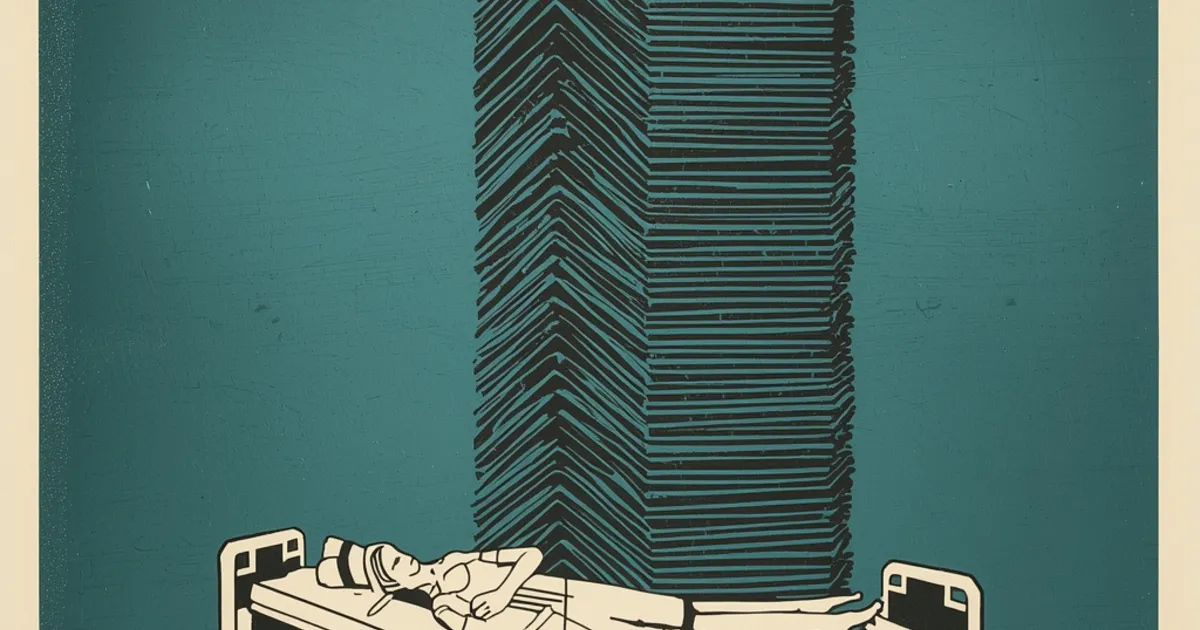
job that produce nothing. A nurse's job is essential; the fourth form recording the same visit
may not be.
Those hours can be measured. In 2017, American health insurers and providers spent 34.2% of
all health spending on administration, $2,497 per person. Canada spent 17.0%, or $551 per
person. Before Canada moved to a single public payer, the two countries looked alike
(Himmelstein et al., 2020). Same kind of doctors, same kind of patients. The difference is the
system, and the system decides how much of a working day goes on paperwork.
Australian universities show the same pattern. A 2025 survey of 350 academics at 37
universities found that the two big efficiency moves, centralising administration and
automating it, left staff feeling their administrative load had grown, and that it bit hardest
in teaching and research (Woelert et al., 2025). The work didn't disappear. It moved onto the
people meant to be teaching.
So Graeber and his critics can both be partly right. Few people hold a wholly pointless job.
Many people spend a slice of every week on work that serves nobody.
A company that cut it out
In 2006 Jos de Blok and a small team of nurses in Almelo, in the Netherlands, were fed up
with how the big home care organisations delivered care. They founded Buurtzorg ("neighbourhood care"): self-governing
teams of 10 to 12 nurses, each caring for 50 to 60 people in one neighbourhood, with a simple, flat
structure. Nurses also do the dressing and bathing that
other providers hand to cheaper staff (Wikipedia, 2026e).
By 2018 Buurtzorg employed about 10,000 nurses, and more than half of all district nurses in
the Netherlands work for it. KPMG found it a low-cost provider of home care. Its staff are
the most satisfied of any large Dutch company (Wikipedia, 2026e).
That fits the country. Much of the Netherlands sits below sea level, and for centuries
neighbours had to agree on keeping the dikes up whatever else they argued about. The Dutch
call their habit of consensus the polder model, after the reclaimed land. In 1982,
with the economy in trouble, unions, employers and government signed the Wassenaar Agreement,
trading shorter working time and less pay for more jobs (Wikipedia, 2026f). The
Netherlands has since had the highest share of part-time workers in the EU (Wikipedia, 2026g). A
country used to sharing the work found it natural to trust nurses to run themselves.
Give the hours back
Keynes asked the right question: once there's enough, why keep working as if there
isn't? The aim here is a 22-hour week. Work 22 hours at most, keep your pay,
choose your hours, and work from home where the job allows. It sits between Keynes's 15 hours
and today's 38.
The way there is to cut work that produces nothing, not the work that keeps people fed,
housed, well and taught. Every report nobody reads, every approval that approves nothing, every
system that makes staff type the same thing twice is time that could go back to someone as
rest, care or a life. Trials that cut hours without cutting pay are already running, and the
results are in Does a shorter working week work?
What you can check this week
- Keep a log. For one week, note each task and ask: who uses this, and what
would break if it stopped?
- Find the duplicates. The same information entered twice, the same meeting
held for two audiences, the report that restates another report.
- Take one to whoever sets the rule. Most pointless work isn't anyone's
fault. It's a rule nobody has had time to remove.
Graeber put a rude name on a real feeling. The studies since show the feeling is rarer than
he thought, and more about how work is run. That's the good news. How work is run can
change.
Sources
- Keynes, J. M. (1931). Economic possibilities for our grandchildren. In Essays in
persuasion (pp. 358–373). Macmillan. (Original work published 1930 in The Nation and
Athenæum.) gutenberg.ca
- Soffia, M., Wood, A. J., & Burchell, B. (2021). Alienation is not 'bullshit': An empirical
critique of Graeber's theory of BS jobs. Work, Employment and Society, 36(5), 816–840.
doi.org/10.1177/09500170211015067
- Himmelstein, D. U., Campbell, T., & Woolhandler, S. (2020). Health care administrative
costs in the United States and Canada, 2017. Annals of Internal Medicine, 172(2),
134–142. doi.org/10.7326/M19-2818
- Woelert, P., Chesters, J., Martinussen, M., & Gannaway, J. (2025). Administrative burden in
Australian universities: Insights into dimensions and drivers from a nationwide survey.
Science and Public Policy, 53(2), 171–183.
doi.org/10.1093/scipol/scaf029
- Graeber, D. (2018). Bullshit jobs: A theory. Simon & Schuster.
- Wikipedia. (2026a). National Employment Standards. wikipedia.org
- Wikipedia. (2026b). David Graeber. wikipedia.org
- Wikipedia. (2026c). Bullshit Jobs. wikipedia.org
- Wikipedia. (2026d). The Dawn of Everything. wikipedia.org
- Wikipedia. (2026e). Buurtzorg Nederland. wikipedia.org
- Wikipedia. (2026f). Polder model. wikipedia.org
- Wikipedia. (2026g). Part-time contract. wikipedia.org