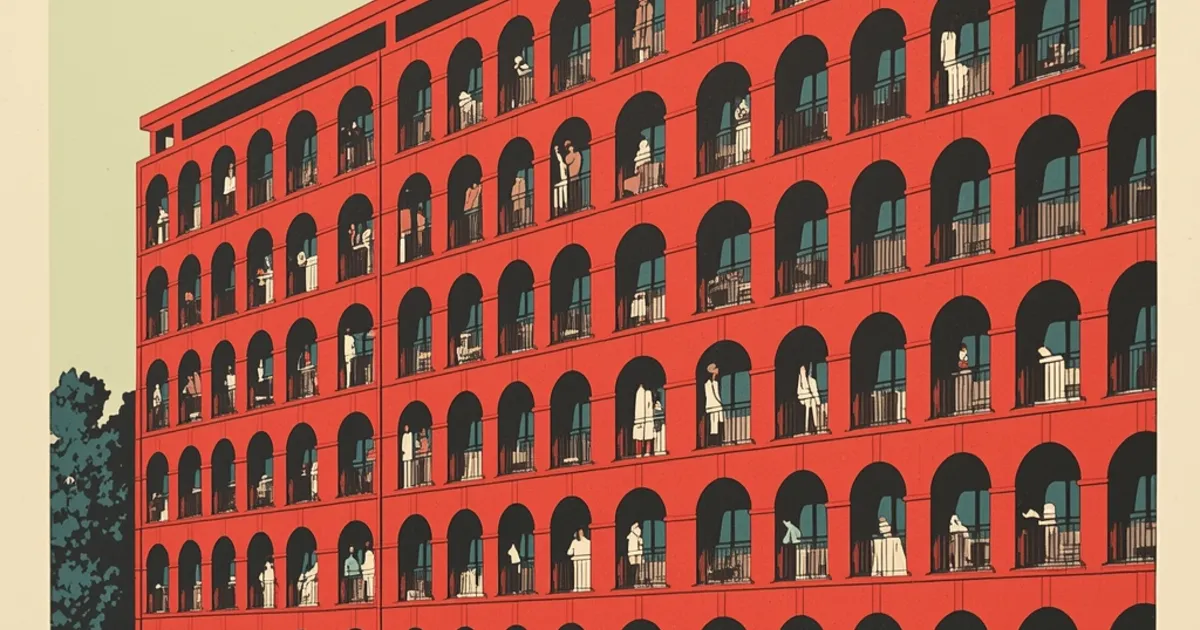
Vienna builds homes to live in, not to trade. The city owns about 220,000 flats,
non-profit builders manage about 200,000 more, and more than 60% of Viennese live in one of
the two. A small tax on every wage pays for it, and the income limit sits high enough that
nurses, teachers and office workers qualify, so nobody treats the address as a mark of
failure.
Start with one idea: housing is for living in, not for speculating on.
Vienna has run on that idea for a hundred years. This article looks at how, and why
Australia doesn't.
A city of bed lodgers
In 1918 Vienna had two million people and nowhere to put them. Most families lived in one
room and a kitchen, with one tap and one toilet per floor. Around 170,000 "bed lodgers" rented
a bed for a few hours a day and slept in shifts. Tuberculosis spread so widely it was called
"the Viennese disease" (City of Vienna, n.d.-a).
In 1919 the Social Democratic Workers' Party won the city council. In 1922 Vienna became a
province of Austria in its own right, and gained the power to set its own taxes. The period
that followed, until 1934, is known as "Red Vienna" (City of Vienna, n.d.-a; Wikipedia,
2026a).
The tax that built a city
The city's finance councillor, Hugo Breitner, rebuilt the tax system around one question:
who can afford to pay? The old rent tax charged every tenant the same rate. Breitner replaced
it with a tax that touched only the top 20% of rents, then in 1923 added an earmarked housing
construction tax (City of Vienna, n.d.-a). It rose steeply with the value of the property:
the most expensive 0.5% of properties paid 44.5% of it (Wikipedia, 2026b).
The city also bought land ahead of time, so it wasn't competing with speculators when it
came to build. In September 1923 the council voted to build 25,000 flats in five years. The
25,000th foundation stone went down in 1926, a year early, and a second programme of 30,000
followed (City of Vienna, n.d.-a).
By 1933 around 200,000 Viennese, about a tenth of the city, lived in the new municipal
flats. Because public money covered the building costs, rents stayed low (City of Vienna,
n.d.-a; Wikipedia, 2026a). The rule for every flat was "fresh air, light and sunshine": no
more than half of any site built on, every room except the hall and toilet with its own
window, and almost every flat with a balcony, bay window or loggia (City of Vienna, n.d.-a).
Karl-Marx-Hof: a kilometre of home
The best-known building from those years is Karl-Marx-Hof, designed by Karl Ehn and
finished in 1930. It runs more than a kilometre along the street, past four tram stops, and
holds more than 1,300 flats for about 5,000 people. Only 18.5% of its land is building. The
rest is gardens and play areas. Inside the complex the city put laundries, baths,
kindergartens, a library and doctors' rooms (Wikipedia, 2026c).
The idea was that a worker's family deserved what a rich family took for granted: light,
green space, a bath, a doctor nearby. Red Vienna ended in the civil war of February 1934,
when the army shelled Karl-Marx-Hof and the people defending it surrendered (Wikipedia,
2026c). The building survived, was refurbished from 1989 to 1992, and families still live in
it.
How it's paid for today
Today the city counts about 220,000 municipal flats and 200,000 subsidised ones, home to
more than 60% of Viennese (City of Vienna, n.d.-g). The system rests on three things (City of
Vienna, n.d.-b, n.d.-c, n.d.-d).
- A housing contribution on every wage. Workers and employers each pay
0.75% of wages, 1.5% in all, and it goes to social housing construction. Because it's tied to
wages, the money keeps coming whichever party is in power.
- Cheap long loans. Builders can borrow at 1% interest for up to 40 years,
covering about 35% of construction costs. While the loan runs, rent is capped at what the
building actually costs.
- Builders who can't take a profit out. Vienna's 54 limited-profit housing
associations charge rents that cover land, building, administration and financing. Any
surplus must go back into land, repairs or new homes. They manage around 200,000 flats and
build about 30% of all new housing in the city each year.
Land for subsidised housing goes out through competitions. The price is fixed in advance,
so developers can't win by bidding more. A jury picks the best project on four tests: social
sustainability, architecture, ecology and cost, and the winner must build what it promised
(City of Vienna, n.d.-e).
The city says that without these subsidies, rents would be a third higher (City of Vienna,
n.d.-c).
Why nobody is ashamed of the address
This is the part most countries miss. In 2026 a single person in Vienna can earn up to
€61,280 a year after tax and still qualify for a subsidised or municipal flat; a couple, up
to €91,320. About 75% of Viennese earn less than the limit (City of Vienna, n.d.-f). The city
set it high on purpose, "to also include middle-class families, couples and singles and,
hence, to improve the social mix" (City of Vienna, n.d.-b). Leases are open-ended, with no
deposit and no agent's fee.
So the neighbours in a Gemeindebau, a municipal block, are a mix: a bus driver, a retired
teacher, a young couple, a family who arrived with nothing. Living there says nothing about
who you are. Austria's national broadcaster, ORF, ran a comedy called Kaisermühlen
Blues from 1992 to 2000: 64 episodes about the neighbours on one stairwell of a council
block. It became a cult show (Wikipedia, 2026d). A country where the council block is the
setting for a much-loved comedy thinks of it as an ordinary place to live.
Where it falls short
Vienna's model has limits, and they're worth knowing.
- Newcomers wait. Applicants need two years at a Vienna address, and
Austrian citizenship or an equivalent status such as EU citizenship, refugee status or
long-term residence (City of Vienna, n.d.-f). People who have just arrived, often the ones
paying the highest private rents, can't apply yet.
- Demand outruns supply. The city finished no new municipal block between
2004 and 2019. It decided in 2015 to build again "due to the high demand for particularly inexpensive
housing", and opened the first new one, Barbara-Prammer-Hof, in 2019 (City of Vienna,
n.d.-a, n.d.-b). A points system gives extra weight to single parents, crowded families and
people about to lose their home.
- Management slips. At the end of 2017 about 9,000 of the city's 209,000
municipal flats, 4.25%, stood empty (Wikipedia, 2026e).
And Australia?
At June 2025 Australia had almost 452,000 social housing dwellings, home to about 799,000
people. That's 4.0% of households, down from 4.7% in 2013 (AIHW, 2026). Most new homes go to
people in the greatest need: 79% of new allocations in 2022–23 (AIHW, 2024).
That targeting is kind in intent: the scarce homes go to those with nowhere else. But when
social housing is only for those in crisis, the address comes to mean crisis. Vienna does the
opposite. It builds enough for most people to qualify, so the homes carry no label.
The comparison has a catch: Vienna is one city with a century's head start, and Australia is
a continent. But the tools aren't unique to Vienna. A wage-linked housing fund, builders who
must reinvest their surplus, land sold on quality rather than price, and income limits high
enough to include the middle: none of these needs a revolution. Supply is also what makes
Housing First work;
without homes to put people in, even the best programme stalls.
What to check where you live
- What share of homes in your state are social housing, and is it rising or falling?
- Who qualifies? If only people in crisis do, the homes will carry a stigma.
- Is there money tied to something steady, like wages, or does housing depend on each
year's budget?
- When public land is sold, does it go to the highest bidder or the best project?
Hugo Breitner's tax asked the people with most to pay the most, and a hundred years later
more than half the city lives in what it built. Housing for living isn't a dream. Vienna has
done it since 1923.
Sources
- Australian Institute of Health and Welfare. (2024). Housing assistance in Australia
2024. aihw.gov.au
- Australian Institute of Health and Welfare. (2026). Housing assistance in Australia
2026. aihw.gov.au
- City of Vienna. (n.d.-a). History: 100 years of social housing. Wiener Wohnen.
socialhousing.wien
- City of Vienna. (n.d.-b). Municipal housing in Vienna. Wiener Wohnen.
socialhousing.wien
- City of Vienna. (n.d.-c). Housing subsidies. Wiener Wohnen.
socialhousing.wien
- City of Vienna. (n.d.-d). Limited profit housing construction. Wiener Wohnen.
socialhousing.wien
- City of Vienna. (n.d.-e). Developers' competitions. Wiener Wohnen.
socialhousing.wien
- City of Vienna. (n.d.-f). Flat allocation criteria. Wiener Wohnen.
socialhousing.wien
- City of Vienna. (n.d.-g). The Vienna model. Wiener Wohnen.
socialhousing.wien
- Wikipedia. (2026a). Red Vienna. wikipedia.org
- Wikipedia. (2026b). Gemeindebau (German). wikipedia.org
- Wikipedia. (2026c). Karl-Marx-Hof. wikipedia.org
- Wikipedia. (2026d). Kaisermühlen Blues (German). wikipedia.org
- Wikipedia. (2026e). Stadt Wien – Wiener Wohnen (German). wikipedia.org