The Dutch weren't born on bikes. In the early 1970s their roads killed more
than 400 children a year, and parents took to the streets to stop it. The government
listened, and rebuilt the country's streets around people instead of cars. Today three in
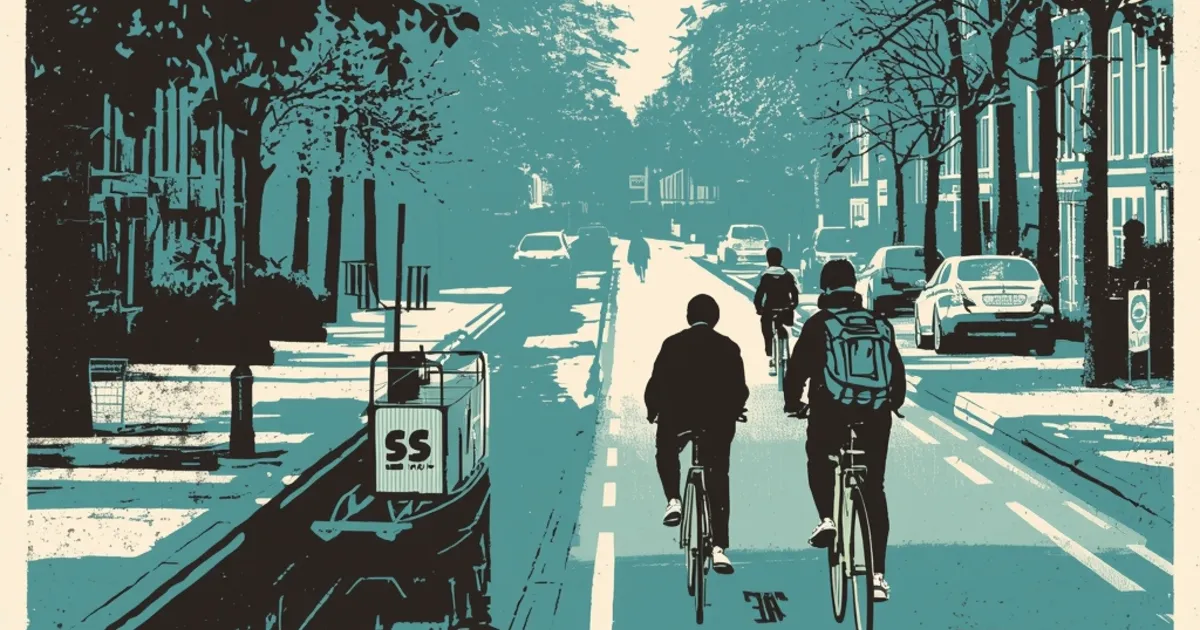
four Dutch secondary students cycle to school.
A country losing its children
Mass car ownership reached Europe after the Second World War, and Dutch cities made room
for it. Traffic deaths rose every year from the 1950s and peaked at 3,267
in 1972. In 1971 alone, drivers killed more than 400 children (Wikipedia, 2026a).
In 1972 Vic Langenhoff, a writer at the newspaper De Tijd, lost his young
daughter to a car. He wrote a front-page piece under the headline Stop de
Kindermoord: "Stop the child murder" (Wikipedia, 2026a; Wikipedia, 2026b).
The words stuck because they were plain. Nobody called it a "road trauma statistic".
A father called it what it felt like, and a country recognised it.
Parents took the streets back
A group formed in March 1973 under that name, with Maartje van Putten, later a member of
the European Parliament, as its first president (Wikipedia, 2026a; Wikipedia, 2026b). It
didn't just write letters.
- Members occupied intersections, such as a crossing on Albert Cuypstraat in
Amsterdam.
- They ran a National Street Play Day, closing streets so children could play in
them.
- They helped residents' groups fix the traffic in their own neighbourhoods.
(Wikipedia, 2026b)
The cultural insight is in the second item. The protest wasn't only against cars. It was
for children in the street, as if a street belonged to the people who lived on
it.
Ten Sundays without cars
Then came luck, of a kind. In late 1973 the oil crisis hit, and the Dutch government
banned driving on Sundays. For ten Sundays, from 4 November 1973 to 6 January 1974, the
roads emptied. People dusted off horse carriages, and cyclists and roller skaters took over
the boulevards (Wikipedia, 2026c).
The ban barely saved any fuel. People drove on Saturday instead and came home late
Sunday night (Wikipedia, 2026c). But for ten weekends, a whole country saw its streets
full of people, quiet and safe. The protests and the oil shortages together turned
government policy around (Wikipedia, 2026d).
What they built
Here's a story worth knowing. In Delft, residents tired of speeding cars went out late at
night and tore up their own street's paving, so drivers had to slow down around the
obstacles. The idea became the woonerf, a "living street" shared by people and
slow cars. In 1976 it went into the national street design standards. Cars in a woonerf
are limited to 15 km/h, and by 2011 about 2 million Dutch people lived on one (Wikipedia,
2026e).
Over the next decades the country built the rest.
| The Netherlands now | Figure |
|---|
| Cycle track physically separated from cars | about 35,000 km |
| Bicycles | about 18 million, 1.3 per person old enough to ride (2012) |
| Share of all trips made by bike | 27% |
| Secondary students who cycle to school | 75%, and 84% of those within 5 km |
(Wikipedia, 2026d)
And the roads became safe. By 2013, deaths had fallen 83% from the 1972 peak, to a
record low of 570 (Wikipedia, 2026a). The country with the most people on bikes made its
roads safer, not deadlier.
What the ride to school does for a child
Riding to school is exercise that happens without anyone scheduling it. A review of 68
studies found that children who walk or cycle to school are mostly more active overall, and
that cycling to and from school is linked with better heart and lung fitness (Larouche et
al., 2014).
The habit pays off into adult life. A UK study of commuters found that people who cycled
to work had a lower risk of heart disease, of cancer, and of dying from any cause, than
people whose commute involved no activity. Their risk of dying was about 40%
lower (Celis-Morales et al., 2017). That study observed people rather than assigning them
to bikes, so some of the gap may come from who chooses to cycle. The direction still
matches every other line of evidence on moving more.
If you want to know how much daily movement matters, see
How much movement undoes a day of
sitting?
Australia went the other way
In 1971 most young Sydney children walked to school: 57.7% of those aged 5 to 9. By
1999 to 2003, it was 25.5%. Car trips rose from 22.8% to 66.6% (van der Ploeg et al.,
2008).
Australian parents aren't lazier or more fearful by nature. Both countries faced the
same rising car traffic in the same years. The Dutch built streets where a child could ride
safely, and Australia mostly built streets for cars. Parents in each country made the
sensible choice for the streets they had.
The hopeful part
None of this took a miracle. It took a father willing to say the plain words, parents
willing to stand in an intersection, and residents willing to dig up their own street. It
took about a generation, and the result is still carrying children to school every
morning.
Things you can do or check:
- Walk or ride the route to your local school with a child, and note every point where
you'd hold their hand. Those are the places to fix.
- Ask your council whether the streets around the school can close to cars at drop-off
and pick-up, or run a street play day.
- Ask what share of the council's transport budget goes to footpaths and separated bike
lanes.
Streets are built. Whoever speaks up decides who they're built for.
Sources
- Celis-Morales, C. A., Lyall, D. M., Welsh, P., Anderson, J., Steell, L., Guo, Y., Maldonado, R., Mackay, D. F., Pell, J. P., Sattar, N., & Gill, J. M. R. (2017). Association between active commuting and incident cardiovascular disease, cancer, and mortality: Prospective cohort study. BMJ, 357, j1456. doi.org/10.1136/bmj.j1456
- Larouche, R., Saunders, T. J., Faulkner, G., Colley, R., & Tremblay, M. (2014). Associations between active school transport and physical activity, body composition, and cardiovascular fitness: A systematic review of 68 studies. Journal of Physical Activity and Health, 11(1), 206–227. doi.org/10.1123/jpah.2011-0345
- van der Ploeg, H. P., Merom, D., Corpuz, G., & Bauman, A. E. (2008). Trends in Australian children traveling to school 1971–2003: Burning petrol or carbohydrates? Preventive Medicine, 46(1), 60–62. doi.org/10.1016/j.ypmed.2007.06.002
- Wikipedia. (2026a). Stop de Kindermoord. wikipedia.org
- Wikipedia. (2026b). Stop de Kindermoord [Dutch]. nl.wikipedia.org
- Wikipedia. (2026c). Autoloze zondag [Dutch]. nl.wikipedia.org
- Wikipedia. (2026d). Cycling in the Netherlands. wikipedia.org
- Wikipedia. (2026e). Woonerf. wikipedia.org




,_Mo_i_Rana,_Norway_2017-10-09_a.jpg)
