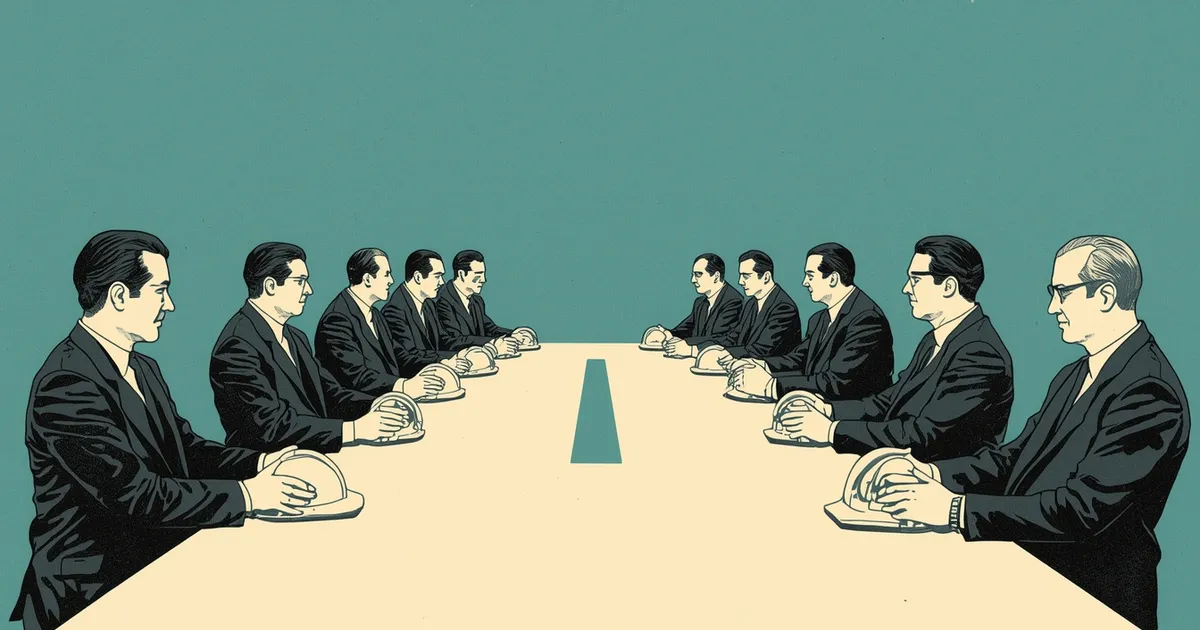
In Denmark a boss can let people go with little fuss. The worker falls into a net
built for it: up to 90% of previous pay from an unemployment fund, and a job centre whose task
is the next job. The Danes call it flexicurity. A job loss becomes the system's problem, not
the family's.
Three parts that only work together
The word comes from Poul Nyrup Rasmussen, Denmark's prime minister in the 1990s. The
government describes the model as a "golden triangle" (Wikipedia, 2026a):
- Flexibility. Employers hire and fire easily, so they take a chance on
new people.
- Security. A worker who loses a job keeps most of the income while
looking for the next one.
- Active help. Job centres, training and job placements, "with rights and
obligations for the unemployed".
Take away any corner and the other two fail. Easy firing with no income is fear. Income
with no help to move on is a waiting room. Help with no easy hiring leads nowhere.
People move a lot. Each year about 30% of private-sector employees leave their job, for a
new one, retirement or unemployment (Wikipedia, 2026b), and the average job lasts about eight
years, one of the shortest in the OECD (Wikipedia, 2026c). Moving on is normal, so losing a
job carries less shame.
The unemployment funds belong to the workers
Most countries pay unemployment benefits from a government office. Denmark, Sweden,
Finland and Iceland run the Ghent system, named after the Belgian city where it began: the
funds are run mainly by trade unions, and the state regulates and part-funds them
(Wikipedia, 2026d).
A Dane joins an a-kasse, a state-recognised unemployment fund, and pays a
membership fee. Most funds are tied to a union. After a year of membership a member who
loses a job can draw up to 90% of previous pay (Wikipedia, 2026c), for up to two years
(Wikipedia, 2026b). Members and the state share the bill. Before 2008 the low payouts were
covered almost entirely by members' fees. After the crash the state paid about half
(Wikipedia, 2026e).
That arrangement holds the unions together too. When Sweden cut state support for its
funds, union membership fell from 77% in 2006 to 71% in 2008 (Wikipedia, 2026d). The funds
and the unions keep each other alive.
Why it fits the Danes
The model rests on an old deal. In the September Compromise of 1899, Danish employers and
unions agreed to settle wages and conditions between themselves, and they still largely do
(Wikipedia, 2026a). For more than a century, bosses and workers have treated each other as
partners who must strike bargains, not enemies waiting for a judge.
That runs on trust. In the most recent surveys, 74% of Danes said most people can be
trusted. In Australia 49% said so, and in the United States 37% (Our World in Data, 2024).
Where people trust each other, a boss can let someone go without a lawyer, and a worker can
accept it without assuming the worst, because the next step is already arranged. The loss
belongs to the economy, so the economy catches it.
A shipyard closes
For decades the Lindø shipyard at Munkebo, near Odense, built some of the biggest ships in
the world, including Maersk's giant container ships. In 2005 it employed 3,200 people
(Wikipedia, 2026f). Then shipping collapsed in the 2008 crash, and Maersk ordered its next
giant ships from Daewoo in South Korea, which was cheaper. In 2009 Maersk announced it would
close the yard. The last ship, the navy frigate Niels Juel, left in January 2012
(Wikipedia, 2026g).
A town built around one employer is where job losses hurt most. What happened next was
the good part. The port of Odense bought the site in 2014 (Wikipedia, 2026h). The yard is
now the Lindø Offshore Renewables Centre: more than a million square metres where over 50
companies build, store and ship wind turbines and other heavy offshore parts, and take old
navy ships apart (Wikipedia, 2026f, 2026g, 2026h). The cranes that built container ships now
load wind farms.
We couldn't find a published count of where each shipyard worker went, so we won't guess.
What the numbers do show is the pattern: across Denmark, about seven in ten workers who lose
a job in a mass layoff or closure are working again within a year (OECD, 2016).
What an Australian gets
| After losing a job | Denmark | Australia |
|---|
| Income | Up to 90% of previous pay, from your fund | JobSeeker: $824.90 a
fortnight for a single adult with no children (from 20 September 2026) |
| Depends on | A year of fund membership | Your savings, assets and your
partner's income |
| How long | Up to two years | While you pass the income and assets
tests |
(Services Australia, 2026)
Most employers must also pay redundancy pay of 4 to 16 weeks, depending on years of
service, but most small businesses don't have to (Fair Work Ombudsman, 2026a). JobSeeker works out to $412.45 a week. The National Minimum Wage is $1,004.90 a week
(Fair Work Ombudsman, 2026b). A worker made redundant from a full-time job on the minimum
drops to about 41% of that income, and a worker on an average wage drops much further. It's
a payment built to stop poverty, not to carry anyone to the next job.
One fact stops that being misread. Australia isn't bad at getting people back to work.
Before the 2008 crash, about 74% of Australians who lost a job were working again within a
year, close to Denmark's 72% (OECD, 2016). The countries count it differently, so treat
those as roughly equal. The difference is what happens to a family's income in between,
and whether a mortgage survives the gap.
What it costs
It isn't cheap, and the Danes pay for it.
- Tax. Denmark collects about 42% of its GDP in tax, Australia about 30%
(Our World in Data, 2025).
- Help costs money. In 2005 Denmark spent about 1.7% of GDP on getting
people back to work, the most in the OECD (Wikipedia, 2026b).
- The net has tightened. Benefits now end after two years, and for
people under 30 in activation programs they halve after six months (Wikipedia, 2026b).
- Critics say the word is vague. Some call flexicurity "a purely
linguistic combination of opposites" that can describe almost any policy mix (Wikipedia,
2026a).
The cost is real. So is the return: bosses willing to hire, workers willing to move, and
a closed shipyard turned into a wind industry instead of a ghost town.
What we can do instead
- Treat job loss as shared risk. Workers and employers already pool risk
through super and workers' compensation. Income insurance for job loss, run by the people
it covers, is the same idea.
- Reward cooperation. Denmark's model began with employers and unions
agreeing to solve things together. The next closure goes better when the plan for the
workers starts before the gates shut.
- Cut the work that produces nothing. Chasing a payment through forms
and appointments that don't lead to a job wastes the time the person needs to find one.
More on how much work we could drop in
Do shorter working weeks work?
Check it yourself: if you lost your job this Friday, how many weeks would your savings
last on $412 a week? That number is the size of the gap Denmark decided to close.