Partly. Compulsory schooling began in Prussia in 1763, and historians describe it as
part of a campaign to strengthen the king's authority. But the popular story is too neat. What
matters more is testing today's habits, such as homework for young children, against the
evidence. Some of them don't pass.
What happened in Prussia
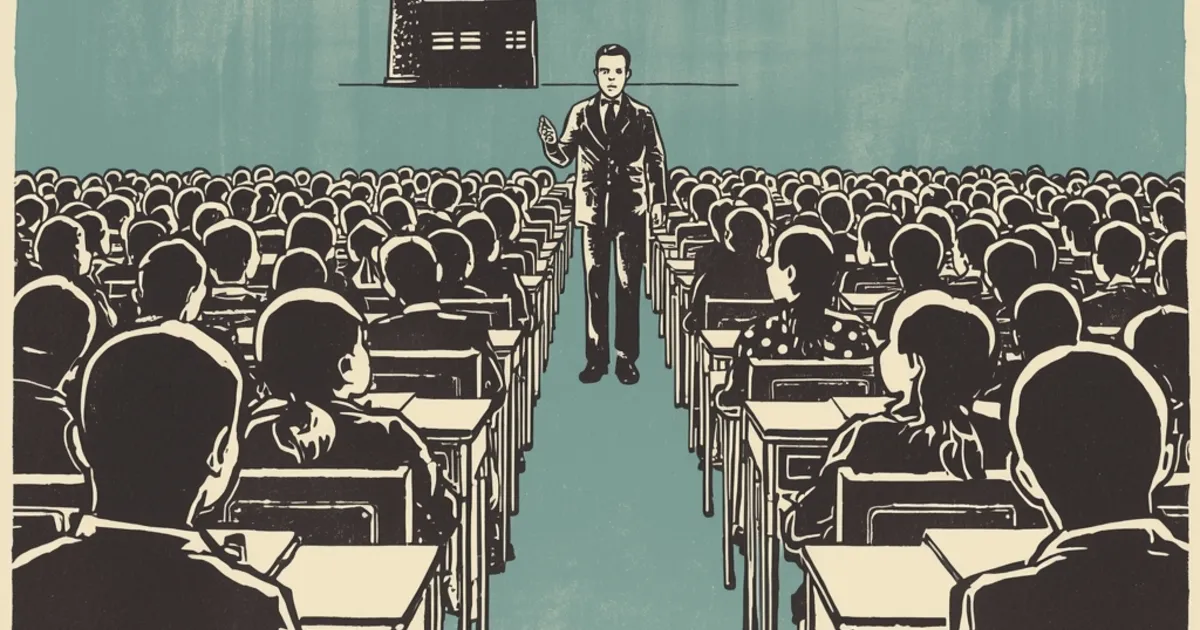
In 1763, at the end of the Seven Years' War, Frederick the Great of Prussia issued the
General-Land-Schul-Reglement. It ordered boys and girls into school from age five until 13 or
14, to learn Christianity, reading and writing. It set fees, helped very poor children, laid
down what to teach and put teachers under inspection. Few states had tried anything like
it.
Historian James Van Horn Melton studied this period in Absolutism and the Eighteenth-Century
Origins of Compulsory Schooling in Prussia and Austria (1988). Melton shows school reform was part of a
wider campaign to strengthen relationships of authority and dependence between rulers and
subjects. So yes: the state built the first mass schools partly to shape loyal, orderly
people.
How it spread, and where the story gets too simple
Horace Mann, secretary of the Massachusetts Board of Education, toured European schools
and wrote them up in his Seventh Annual Report (1843). It ranked Prussia first and argued
for a complete overhaul of Boston's schools. Prussian ideas shaped American public schooling,
and American ideas shaped much of the world.
Look at what Mann praised, though. Mann admired the Prussian teaching methods of Johann
Pestalozzi, a Swiss reformer who wanted children to learn through their senses and their own
activity, not rote. Mann did not bring home a blueprint for obedience. The rows, bells and
age grades most of us know came together over the following century, from many sources.
One of them was the business thinking of the early 1900s. Ellwood Cubberley, a Stanford
professor of education, wrote in 1916 that "our schools are, in a sense, factories in which the
raw products (children) are to be shaped and fashioned into products to meet the various
demands of life." The factory comparison is not a modern insult. Its supporters used it
first.
The origin story explains why schools look the way they do. It does not prove any practice
is harmful. For that, we must look at the evidence one practice at a time.
Homework in primary school
Harris Cooper and colleagues pulled together research from 1987 to 2003 on homework and
achievement. The link was clear in high school, weaker in middle school, and small in the
primary years. Homework for young children can build work habits, but it does little for
their marks. Every hour it takes comes out of play, sleep and family time.
Child-led classrooms
A study in Science in 2006 used a natural experiment. A public Montessori school in
Milwaukee filled its places by lottery, so Angeline Lillard and Nicole Else-Quest could compare
children who won a place with children who applied and missed out. At five, the Montessori
children did better at early reading and maths, showed more advanced social understanding and
self-control, and cared more about fairness. At twelve, they wrote more creative essays and felt
a stronger sense of community at school.
It is one school and a small sample, and later studies are mixed. But it shows a classroom
built on choice, mixed ages and long work periods can match or beat a conventional one on
the conventional measures.
Finland starts later
Finnish children begin comprehensive school at seven. Before that, early childhood
education follows a national curriculum that promotes learning through play, with a year of
pre-primary education at six. Finland's results are not proof that late starts cause good
outcomes; the country differs from others in many ways. It does show that starting formal
lessons at five is a choice, not a law of nature.
A statistic to stop sharing
You may have seen the claim that 98 per cent of five-year-olds score as "creative geniuses"
on a NASA test, falling to 2 per cent of adults. It comes from George Land, who told it in a
1992 book and a TEDx talk. No one has found a published study behind it, with its method,
sample or data. Don't repeat it.
A real measure exists. Kyung Hee Kim analysed Torrance Tests of Creative Thinking norms
covering more than 270,000 people and found creative thinking scores in the United States fell
from 1990, while IQ scores rose. The fall was sharpest from kindergarten to third grade.
That tells us creativity scores dropped, not what caused the drop.
What you can check at your school
- How much homework do the youngest classes get, and why? Ask what evidence the school relies on.
- How much free, outdoor break time do children get each day? Is it ever taken away as punishment?
- How much of the day do children spend choosing their own work?
- Are young children taught in play, or sat at desks?
School's history tells us where our habits came from. The evidence tells us which to keep.
Sources
- Cooper, H., Robinson, J. C., & Patall, E. A. (2006). Does homework improve academic achievement? A synthesis of research, 1987–2003. Review of Educational Research, 76(1), 1–62. doi.org/10.3102/00346543076001001
- Cubberley, E. P. (1916). Public school administration. Houghton Mifflin.
- Finnish Ministry of Education and Culture. (n.d.). Finnish education system. okm.fi/en/education-system
- Finnish National Agency for Education. (n.d.). National core curriculum for ECEC in a nutshell. oph.fi
- Frederick II of Prussia. (1763). General-Land-Schul-Reglement. English translation in German History in Documents and Images. germanhistorydocs.org
- Kim, K. H. (2011). The creativity crisis: The decrease in creative thinking scores on the Torrance Tests of Creative Thinking. Creativity Research Journal, 23(4), 285–295. doi.org/10.1080/10400419.2011.627805
- Land, G., & Jarman, B. (1992). Breakpoint and beyond: Mastering the future today. HarperBusiness.
- Lillard, A., & Else-Quest, N. (2006). Evaluating Montessori education. Science, 313(5795), 1893–1894. doi.org/10.1126/science.1132362
- Mann, H. (1844). Seventh annual report of the Board of Education, together with the seventh annual report of the Secretary of the Board. Dutton and Wentworth.
- Melton, J. V. H. (1988). Absolutism and the eighteenth-century origins of compulsory schooling in Prussia and Austria. Cambridge University Press.