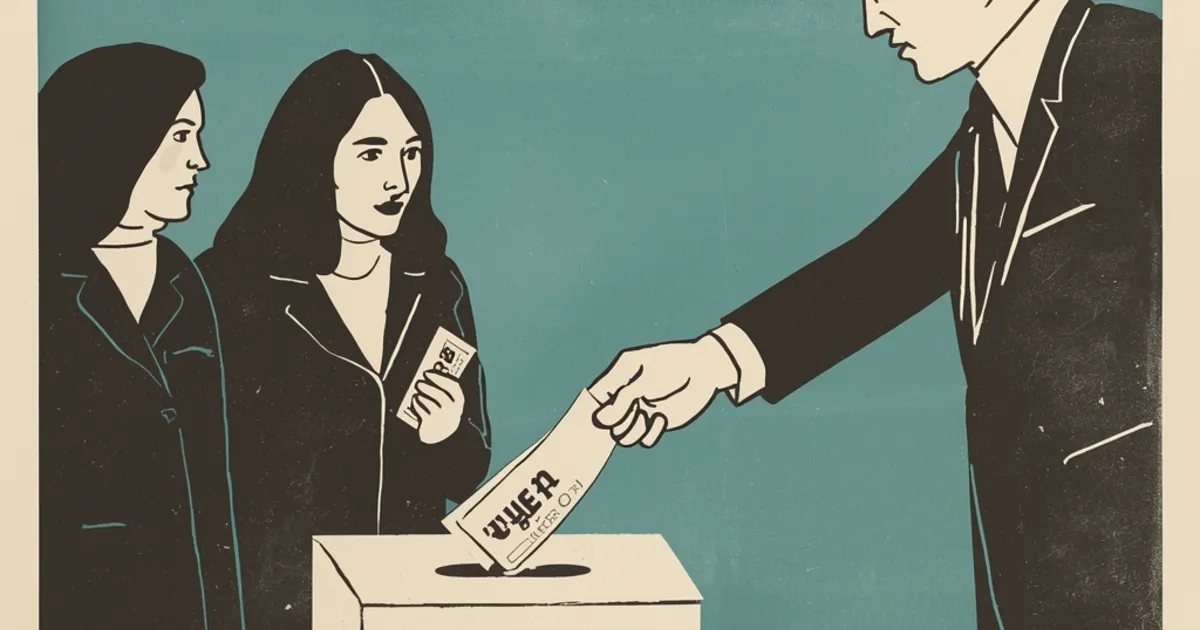
Once a year, the citizens of the Swiss canton of Glarus stand together in the open square of their capital and make their laws by raising their hands. In 2006 the question in front of them was their own size. The government had proposed folding the canton's 25 municipalities into ten. After emotional speeches and several proposals from the crowd, by the narrowest of majorities, they voted for three (Canton of Glarus, n.d.; Südostschweiz, 2021).
Soft clusters of leaves fall without a plan to the ground. A forest manages this without a ministry.
The radical crowd
It's still the most radical municipal reform Switzerland has seen. Opponents tried to undo it, and in November 2007 everyone gathered in the square again and confirmed it, clearly. On 1 January 2011 the three new municipalities came into being.
Picture what that means. A crowd of neighbours, in the open air, went further than their own government dared, on the question of how big they should be. You don't often see that. Most of us have never been asked. Yet size might be the biggest thing about any system we live in, and the one we think about least.
Every bad system was a good idea once
Here's an uncomfortable claim: every destructive system we live under began as an attempt at something good.
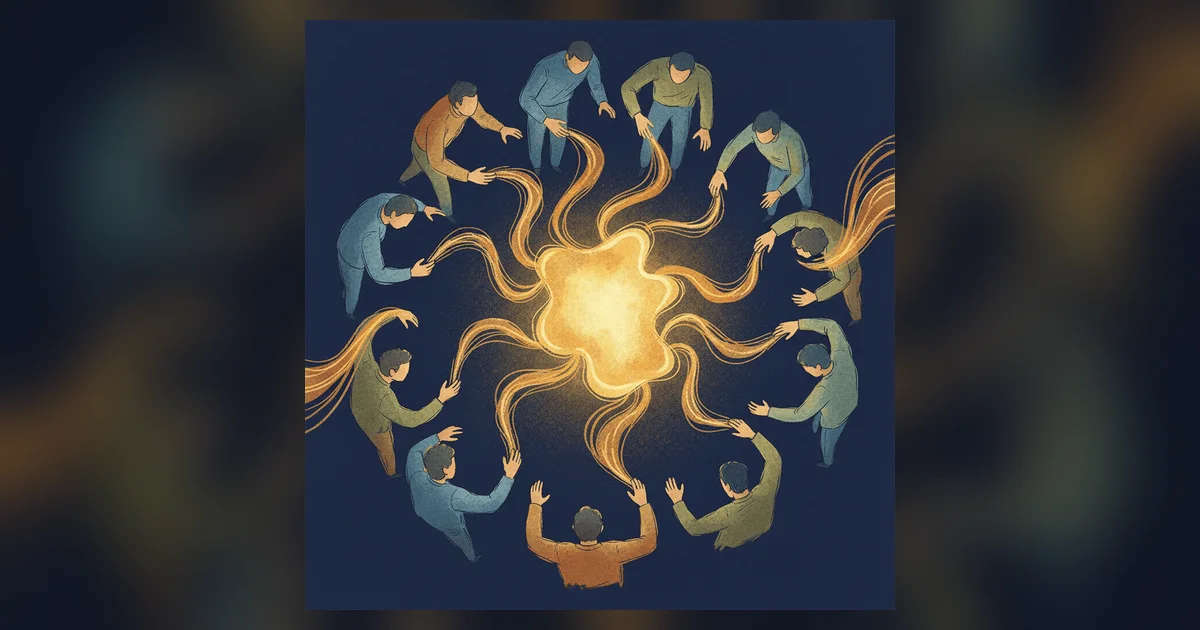
Money began as a way for strangers to cooperate. Courts began as a way to protect the group. Schools began as knowledge for everyone. The press began as sharing what we know. Government began as deciding together. Each worked when the group was small enough that reputation was visible and trust could be checked. Robin Dunbar famously put a number on that ceiling, around 150 stable relationships (Dunbar, 1993). Other researchers rerunning his method got such a wide range of estimates that they doubt any single number holds up (Lindenfors et al., 2021). The exact figure doesn't matter much. Everyone has been to a meeting that had too many people in it. Hutterite colonies in North America split on purpose as they grow, at about that size, and they've learned over generations why.
Above the ceiling, the job gets handed to an institution, and institutions can be captured. Then the thing built to protect people starts to grind them.
Why tearing it down fails
The instinct is to abolish. But abolition removes the institution and leaves the need. People still have to trade with strangers and still need protection, and under pressure they rebuild fast and crude. China's Great Leap Forward tore up how a nation fed itself, and the famine killed tens of millions; the historian Frank Dikötter puts it at forty-five million (Dikötter, 2010).
Zoos met a gentler version of this with captive animals. In 1907 Carl Hagenbeck opened a park near Hamburg with moats instead of bars (Rothfels, 2002), and the method that followed is slow and humble: start from what the species needs, change one thing, watch the animal, keep what works. Nobody burned the old zoos. They were rebuilt, one enclosure at a time.
What the Swiss numbers say
If scale is where systems break, it should show where big and small groups govern themselves under identical rules. Several times a year every Swiss citizen votes on the same national proposals on the same day, and the results are published for every commune, from villages of 31 voters to Zürich.
Take the four federal vote days of 2024, across 2,105 communes (Federal Statistical Office, 2024). Communes with 150 voters or fewer turned out at 56.3%. Communes with more than 10,000 turned out at 48.4%. Compare each commune only with its neighbours in the same canton, and turnout fell about 3.7 points each time a commune was ten times bigger. It held on every one of the four days, whatever was on the ballot. The drop is steepest from village to town, then levels off: once a place is a town of strangers, making it bigger costs less.
Same question. Same day. Same rules. The smaller the group, the more of it turned up to decide.
That can't show smaller units cause higher turnout. Communes differ in age, wealth and rurality even within a canton, and turnout is one measure of self-government among many. The stronger test is a merger, which makes a commune larger overnight while its people stay the same. Which brings us back to Glarus. Did their crowd vote away the very thing that kept them turning up? It's a question someone should answer with their data, and it's a fair worry to hold. There's a trade-off here too: small places can run on gossip, and they can be cruel to whoever doesn't fit. Glarus's voters also wanted something a village can't always give them: services that work.
Four rules for building at human size
Build at a size people can know. Arrange the setting for learning instead of drilling people; Montessori classrooms, tested by lottery, did better on reading and mathematics at age five (Lillard & Else-Quest, 2006). Check every need at once, the way zoo welfare scores the whole animal and not just its food. And stop hiding death, because knowing time is finite is what makes it worth spending well.
The conclusion isn't moderate. Organising a society around small clusters would change nearly everything. The method still is: change one thing, then look. The systems aren't evil. They're oversized. So the repair isn't demolition. It's bringing the design back to the size of the animal that has to live in it.
What you can do
You've felt this. It's the difference between a street that knows you and a call centre that doesn't. Most of what's cold in our lives got that way by getting big.
- Before you start anything, or join anything, ask how many people it's for, and whether they'd know each other's names.
- Find the smallest unit of government near you and go. A council meeting often has more seats than people, and your hand counts for more there than anywhere else.
- If your club or school or workplace has grown past knowing everyone, try splitting it, as the Hutterites do. Start something next door.
A leaf has no say in the tree. In Glarus, people raise their hands.
Sources
Canton of Glarus. (n.d.). Reform of municipalities. https://www.gl.ch/gl2011/english.html/366
Dikötter, F. (2010). Mao's great famine: The history of China's most devastating catastrophe, 1958–1962. Bloomsbury.
Dunbar, R. I. M. (1993). Coevolution of neocortical size, group size and language in humans. Behavioral and Brain Sciences, 16(4), 681–694. https://doi.org/10.1017/S0140525X00032325
Federal Statistical Office. (2024). Echtzeitdaten am Abstimmungstag zu eidgenössischen Abstimmungsvorlagen [Real-time data on federal vote days] [Data set]. opendata.swiss.
Lillard, A. S., & Else-Quest, N. (2006). Evaluating Montessori education. Science, 313(5795), 1893–1894. https://doi.org/10.1126/science.1132362
Lindenfors, P., Wartel, A., & Lind, J. (2021). 'Dunbar's number' deconstructed. Biology Letters, 17(5), 20210158. https://doi.org/10.1098/rsbl.2021.0158
Rothfels, N. (2002). Savages and beasts: The birth of the modern zoo. Johns Hopkins University Press.
Südostschweiz. (2021, January 1). Glarner Gemeindereform feiert den zehnten Geburtstag. https://www.suedostschweiz.ch/schweiz-und-welt/glarner-gemeindereform-feiert-den-zehnten-geburtstag-1020237