The famous figure of 150 is shakier than its fame suggests. Re-running the
original method gives numbers anywhere from 2 to 520. What holds up better is that people's
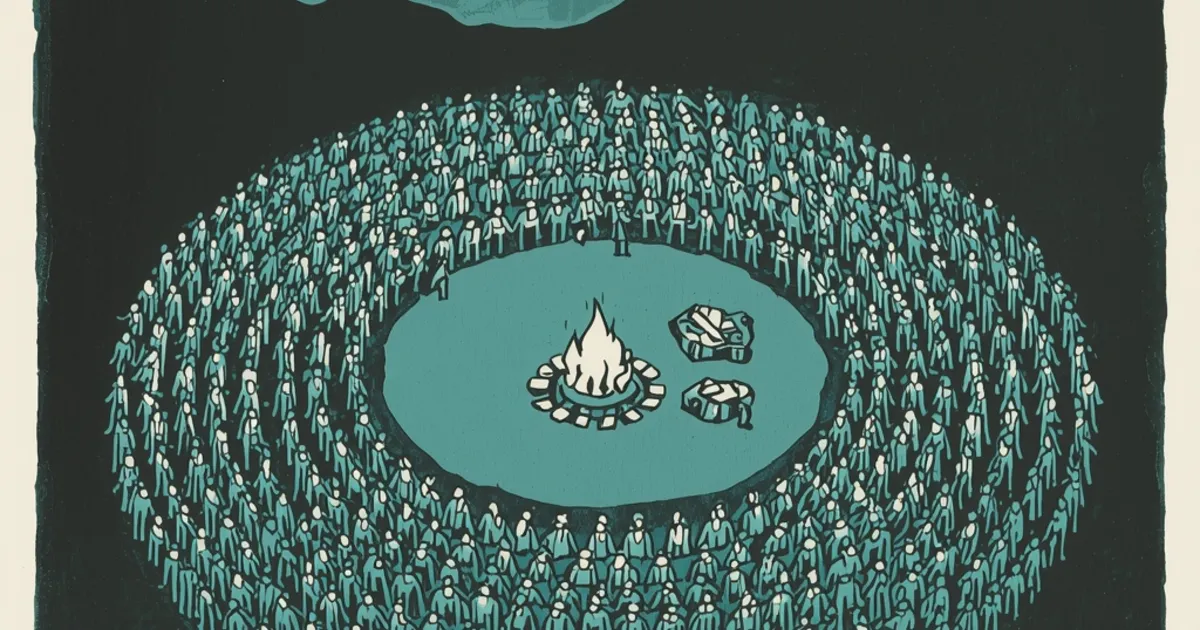
relationships come in layers, from a handful of close ties to a wide ring of acquaintances.
Where 150 came from
In 1992 the anthropologist Robin Dunbar compared primate species. Monkeys and apes with a
larger neocortex, the outer layer of the brain, relative to the rest of the brain tended to
live in larger groups. Dunbar drew a line through the data and extended it to the size of the
human neocortex. The line predicted a group of about 150.
His idea, the social brain hypothesis, says keeping track of relationships is hard mental
work, so the brain limits how many stable relationships a person can hold. The number spread
far beyond science, into management books and advice on team size.
The evidence that seemed to fit
In 2003 Russell Hill and Dunbar asked people in the United Kingdom about the Christmas cards
they sent. Counting everyone in each household that received a card, networks averaged 153.5
people. Counting only people contacted directly, they averaged 124.9. Both sit close to 150.
Family made up a fairly constant share, around 21%.
In 2016 Dunbar surveyed UK adults about Facebook. The number of Facebook friends people
had, and the number they counted as close, looked much like the size of offline networks.
Online tools made contact easier, but did not seem to lift the ceiling on real relationships.
The 2021 re-analysis
In 2021 three Stockholm researchers, Patrik Lindenfors, Andreas Wartel and Johan Lind,
tested whether the primate data actually support a figure of 150. They re-ran the analysis on
several datasets with modern statistical methods.
| Method | Estimated human group size | 95% confidence interval |
|---|
| Bayesian phylogenetic | 69 to 109 | 4 to 520 |
| Generalised least squares | 16 to 42 | 2 to 336 |
A confidence interval that runs from 2 to 520 says the data cannot pin the number down at
all. Their conclusion: a cognitive limit on human group size "cannot be derived in this
manner". Picking any one number from this method is, in their word, futile.
The Christmas card and Facebook studies still stand as descriptions of real networks. But
they show what people in one country report; they do not prove a fixed limit set by brain
size.
What holds up: layers
A 2005 study by Wei-Xing Zhou, Didier Sornette, Hill and Dunbar pooled data on how humans
group themselves. They found groups do not come
in any size. They cluster in a series, each layer roughly three times the one inside it:
around 3 to 5, then 9 to 15, then 30 to 45, and so on outward.
That pattern fits everyday experience. Most people have a few people they would call in a
crisis, a slightly larger circle of close friends, a wider ring of good friends, and a much
larger set of people they know by name. Time, not only brainpower, limits the inner rings:
closeness takes regular contact, and no one has unlimited hours.
Why it matters
- Don't design by a magic number. Teams, schools and communities that split
at exactly 150 are following a figure the data cannot support.
- Do design for layers. Small groups, where everyone knows everyone, suit
trust and support. Bigger groups need other ways to hold together, such as shared rules,
known roles and regular meetings.
- Don't feel you have failed if your circle is smaller or larger than 150.
The figure was never a target.
Check your own circles
- Write down who you would call at 3am in an emergency. That is your innermost layer.
- Add the people you see or speak to most weeks.
- Add the people you would invite to a large celebration.
- Notice where the lists grow sharply. If the inner list is empty or has one name, that is
worth attention: it is the layer that carries you through a bad week.
Sources
- Dunbar, R. I. M. (1992). Neocortex size as a constraint on group size in primates.
Journal of Human Evolution, 22(6), 469–493. https://doi.org/10.1016/0047-2484(92)90081-J
- Hill, R. A., & Dunbar, R. I. M. (2003). Social network size in humans. Human Nature,
14(1), 53–72. https://doi.org/10.1007/s12110-003-1016-y
- Zhou, W.-X., Sornette, D., Hill, R. A., & Dunbar, R. I. M. (2005). Discrete hierarchical
organization of social group sizes. Proceedings of the Royal Society B, 272(1561),
439–444. https://doi.org/10.1098/rspb.2004.2970
- Dunbar, R. I. M. (2016). Do online social media cut through the constraints that limit the
size of offline social networks? Royal Society Open Science, 3(1), 150292.
https://doi.org/10.1098/rsos.150292
- Lindenfors, P., Wartel, A., & Lind, J. (2021). 'Dunbar's number' deconstructed.
Biology Letters, 17(5), 20210158. https://doi.org/10.1098/rsbl.2021.0158

.jpg)

.jpg)
