Yes, in part. Several animals stop cooperating when a partner gets a better
reward for the same work. Children everywhere object when they get less than a peer. The
urge to refuse a better deal for yourself arrives later, and varies more.
The cucumber and the grape
In 2003 Sarah Brosnan and Frans de Waal, at the Yerkes primate centre at Emory University,
tested brown capuchin monkeys. The task was simple: hand a small rock to the researcher and
get food back. Two monkeys worked side by side, able to see each other.
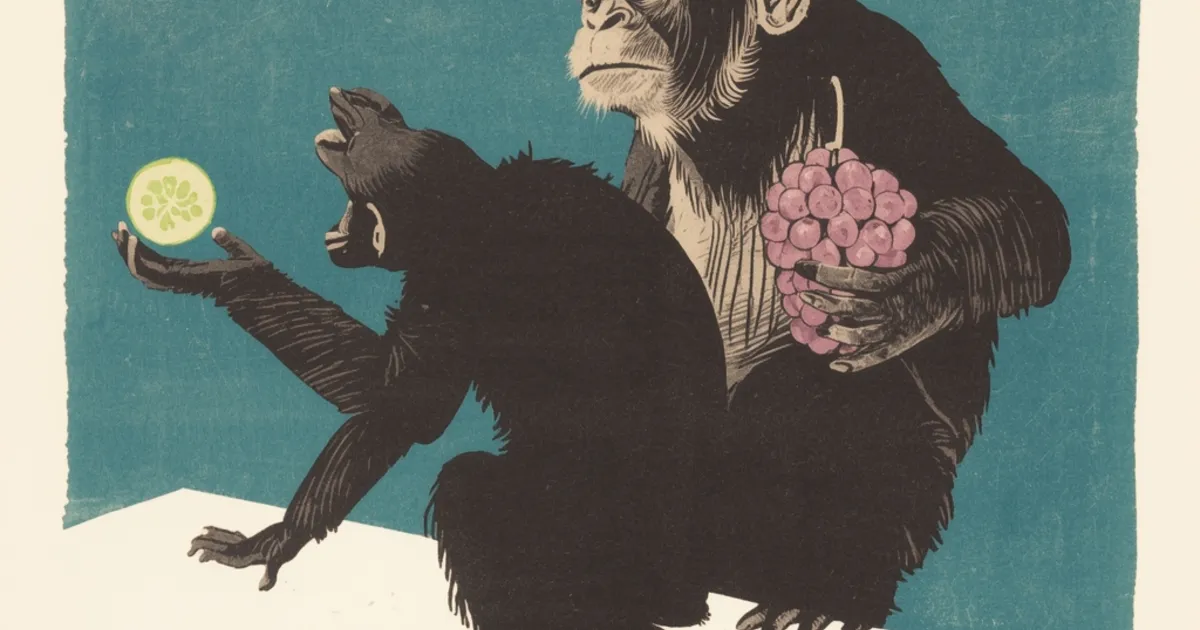
When both got a slice of cucumber, both kept trading. When one monkey started getting grapes,
which capuchins much prefer, for the same rock, the other monkey's behaviour changed. It
refused to trade, or took the cucumber and ignored it, or threw it out of the cage. Rejections
rose further when the partner got a grape for doing nothing at all.
The paper appeared in Nature under the title "Monkeys reject unequal pay". Film of a
capuchin flinging its cucumber back at the researcher has made the study famous far beyond
science.
Other animals do it too
- Dogs. In a 2009 study, dogs asked to give a paw kept doing it for no
reward when alone. When a partner dog got a treat for the same trick and they got nothing,
they stopped much sooner.
- Crows and ravens. In a 2013 study, birds trading tokens for food worked
less when a partner received food as a gift, without working.
- Primates. A 2014 review by Brosnan and de Waal covered more than 35
studies. They reported the reaction mainly in species that cooperate with non-relatives, and
argued fairness sensitivity evolved to protect cooperation: a partner who keeps getting less
will leave, so it pays to notice.
Where the finding stops
Not every study agrees. In 2006 Juliane Bräuer, Josep Call and Michael Tomasello ran the
test on apes with extra controls and found the opposite pattern: apes who saw a partner get
better food stayed longer, not shorter. They argued the monkeys in earlier studies were
reacting to seeing better food they expected to get, not to unfairness as such.
The debate has narrowed since. The reaction is real in several species, but it is about
getting less than a partner. Evidence that animals turn down a better deal for
themselves, because a partner got less, is thin.
Children: two kinds of fairness
Children show both halves, at different ages.
| Reaction | What it means | When it appears |
|---|
| Objecting when you get less | "That's not fair to me." | By middle childhood
in all seven societies tested in a 2015 study, from Canada and the USA to Uganda and
India. |
| Refusing when you get more | "That's not fair to them." | Only in three of the
seven societies, and later in childhood. |
A 2008 Swiss study found the same development within one country. Most three- and
four-year-olds chose selfishly. By seven or eight, almost half would share even with an
anonymous child, and they favoured children from their own group.
Adults differ more than textbooks assumed
Economics long assumed people take whatever they can get. In 2005 Joseph Henrich and a
team of anthropologists ran money-sharing games in 15 small-scale societies, from foragers
to herders to farmers. No group behaved like the purely selfish model. But the groups differed
a lot from one another, and the differences tracked daily life: societies more tied to markets,
and where cooperation paid off, made fairer offers.
So fairness is not one fixed instinct. The reaction to being short-changed looks old and
widespread. How far people go to be fair to others depends heavily on where and how they
grow up.
What to take from it
- If you feel a jolt when someone gets more for the same work, that reaction is shared with
other species and shows up in every culture studied. It is not a character flaw.
- Seeing the other person's reward matters. The monkeys only reacted when they could see the
grape. Pay secrecy removes exactly that signal.
- Generosity toward others is taught and shaped. Schools, families and workplaces that reward
cooperation can grow it.
- When someone cites the cucumber video as proof that humans are "naturally" fair, the honest
version is narrower: primates notice when they get less.
Sources
- Brosnan, S. F., & de Waal, F. B. M. (2003). Monkeys reject unequal pay. Nature,
425(6955), 297–299. https://doi.org/10.1038/nature01963
- Range, F., Horn, L., Virányi, Z., & Huber, L. (2009). The absence of reward induces
inequity aversion in dogs. Proceedings of the National Academy of Sciences, 106(1),
340–345. https://doi.org/10.1073/pnas.0810957105
- Wascher, C. A. F., & Bugnyar, T. (2013). Behavioral responses to inequity in reward
distribution and working effort in crows and ravens. PLoS ONE, 8(2), e56885.
https://doi.org/10.1371/journal.pone.0056885
- Brosnan, S. F., & de Waal, F. B. M. (2014). Evolution of responses to (un)fairness.
Science, 346(6207), 1251776. https://doi.org/10.1126/science.1251776
- Bräuer, J., Call, J., & Tomasello, M. (2006). Are apes really inequity averse?
Proceedings of the Royal Society B, 273(1605), 3123–3128.
https://doi.org/10.1098/rspb.2006.3693
- Fehr, E., Bernhard, H., & Rockenbach, B. (2008). Egalitarianism in young children.
Nature, 454(7208), 1079–1083. https://doi.org/10.1038/nature07155
- Blake, P. R., McAuliffe, K., Corbit, J., et al. (2015). The ontogeny of fairness in seven
societies. Nature, 528(7581), 258–261. https://doi.org/10.1038/nature15703
- Henrich, J., Boyd, R., Bowles, S., et al. (2005). "Economic man" in cross-cultural
perspective: Behavioral experiments in 15 small-scale societies. Behavioral and Brain
Sciences, 28(6), 795–815. https://doi.org/10.1017/S0140525X05000142



.jpg)
