Sometimes. Pictures of watching eyes reduce littering and theft in several real-world
studies. But the famous claim that they make people more generous hasn't held up, and a real
person watching works better than any picture.
The coffee-room experiment
In 2006, Melissa Bateson, Daniel Nettle and Gilbert Roberts ran a simple test in a staff coffee
room at Newcastle University. Staff paid for tea, coffee and milk by dropping coins in an honesty
box. Nobody checked.
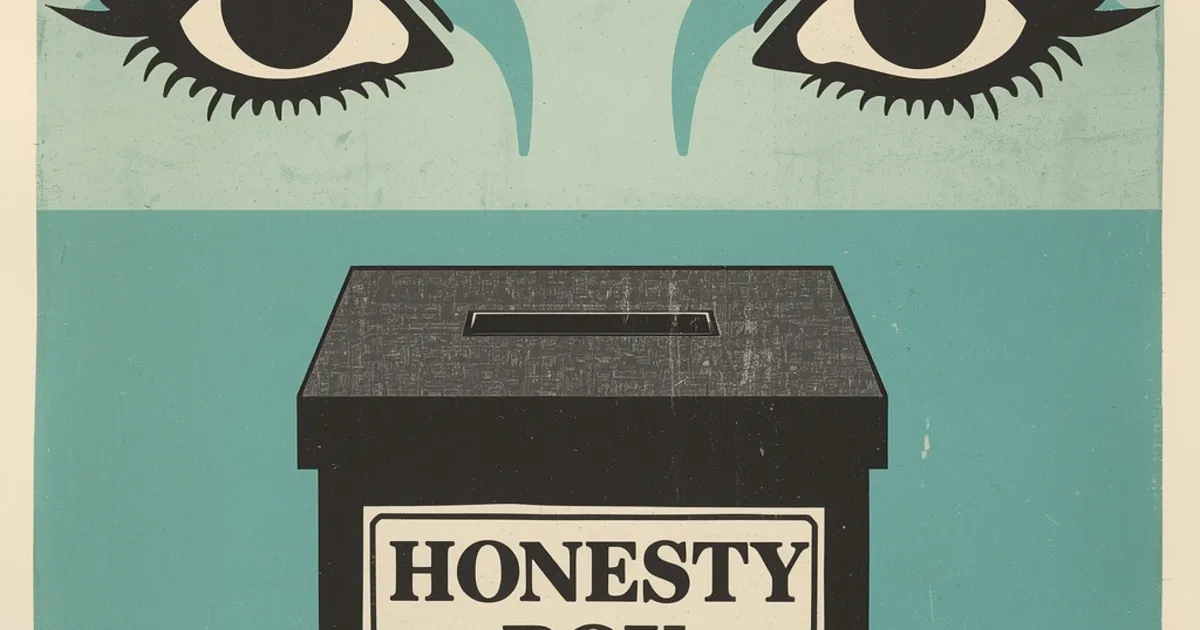
Each week the researchers changed a small picture above the price list. Some weeks it showed
flowers. Other weeks it showed a pair of eyes looking straight at the reader. They measured how
much money went in for each litre of milk used.
In the eyes weeks, people paid nearly three times as much. Nobody was watching, and everyone
knew it was a picture. The researchers called it the first evidence from a real setting that cues
of being watched change how people cooperate.
The idea spread fast. People care about their reputations, and our brains respond quickly to
faces and eyes, so a picture of eyes might switch on "someone could see this" without anyone
noticing.
What happened next
The same team kept testing it outside the lab.
- Litter. In a university cafeteria, posters with eyes made people more likely
to clear their own tables (Ernest-Jones and colleagues, 2011).
- Bike theft. Signs with eyes and the words "Cycle thieves, we are watching you"
went up over three bike racks on a campus. Thefts at those racks fell by 62 per cent over a year.
At racks without signs, thefts rose by 65 per cent (Nettle and colleagues, 2012). The signs
seem to have moved theft somewhere else rather than stopped it.
That second result matters. A sign protects the spot it hangs over, not the whole campus.
Then the reviews came in
One eye-catching study proves little on its own. The real test is what happens when you pool
every study that tried the same thing.
| Review | What it pooled | What it found |
|---|
| Northover and colleagues, 2017 | Lab studies where people chose how much money to give
away | Pictures of eyes did not make people more generous |
| Bradley, Lawrence and Ferguson, 2018 | 117 papers on being observed and helping
others | Being observed has a small positive effect, and it's stronger when a real person
watches than when people only feel watched |
| Dear, Dutton and Fox, 2019 | 15 experiments with 2,035 people on antisocial acts such
as littering and theft | Pictures of eyes cut antisocial behaviour by about 35 per cent |
Put together, the picture is clearer than the headlines. Eye images don't reliably make people
kinder or more generous. They do seem to make people less willing to do something they know others
disapprove of, such as dropping rubbish or taking a bike. And actual people watching beat pictures
of people.
Why the difference?
Researchers are still arguing about it, but one reading fits the evidence. Giving more than you
must is optional, and nobody expects it, so a picture changes little. Littering and theft break a
clear rule, and a reminder that someone could see you is enough to tip some people away from it.
The coffee-room study also fell between the two. Paying for your milk was the rule, so skipping
payment was a small act of cheating, not a failure to be generous.
What it means in everyday life
The broader lesson is older than the eye pictures. In 1961 the writer Jane Jacobs argued that
city streets are safest with "eyes upon the street": windows facing the footpath, shops open,
people around. The reviews point the same way. Being seen by real people shapes behaviour more
than a symbol of being seen.
So:
- A sign with eyes is cheap and may help against littering or theft at one
spot. Expect some of the problem to move next door.
- Don't expect it to raise donations. The pooled evidence says it doesn't.
- Places where people can see each other do more. Shared spaces, windows onto
the street and neighbours who know each other are the real version of the effect.
If you read a claim that a simple trick changes behaviour, look for the review that pooled every
attempt, not the first study. Here, the first study was real, and the effect turned out smaller and
narrower than it first looked.
Sources
- Bateson, M., Nettle, D., & Roberts, G. (2006). Cues of being watched enhance cooperation in a real-world setting. Biology Letters, 2(3), 412–414. https://doi.org/10.1098/rsbl.2006.0509
- Bradley, A., Lawrence, C., & Ferguson, E. (2018). Does observability affect prosociality? Proceedings of the Royal Society B, 285(1875), 20180116. https://doi.org/10.1098/rspb.2018.0116
- Dear, K., Dutton, K., & Fox, E. (2019). Do 'watching eyes' influence antisocial behavior? A systematic review & meta-analysis. Evolution and Human Behavior, 40(3), 269–280. https://doi.org/10.1016/j.evolhumbehav.2019.01.006
- Ernest-Jones, M., Nettle, D., & Bateson, M. (2011). Effects of eye images on everyday cooperative behavior: A field experiment. Evolution and Human Behavior, 32(3), 172–178. https://doi.org/10.1016/j.evolhumbehav.2010.10.006
- Jacobs, J. (1961). The death and life of great American cities. Random House.
- Nettle, D., Nott, K., & Bateson, M. (2012). 'Cycle thieves, we are watching you': Impact of a simple signage intervention against bicycle theft. PLoS ONE, 7(12), e51738. https://doi.org/10.1371/journal.pone.0051738
- Northover, S. B., Pedersen, W. C., Cohen, A. B., & Andrews, P. W. (2017). Artificial surveillance cues do not increase generosity: Two meta-analyses. Evolution and Human Behavior, 38(1), 144–153. https://doi.org/10.1016/j.evolhumbehav.2016.07.001



.jpg)
