Nobody knows for sure. Teenage distress rose sharply after 2010, the years
smartphones spread, but across whole populations the link between screen time and wellbeing is
small. The clearest harm is to sleep, and to the time phones take from friends, play and rest.
The rise is real
The US Centers for Disease Control and Prevention surveys high school students every two
years. In 2021, 42 per cent reported persistent feelings of sadness or hopelessness. Among
girls it was 57 per cent, the highest in a decade, and up nearly 60 per cent since 2011.
Psychologist Jean Twenge and colleagues looked at two national surveys of more than half a
million US students. Depressive symptoms, suicide-related outcomes and suicide rates all rose
between 2010 and 2015, most of all among girls. Teenagers who spent more time on phones and
social media were more likely to report mental health problems. Those who spent more time in
person with friends, at sport, on homework, reading print or at religious services were less
likely to.
Jonathan Haidt's 2024 book The Anxious Generation built on this work. It argues that
a "phone-based childhood" replaced a play-based one, and that this causes much of the rise.
It sparked phone bans in schools across several countries.
Why many scientists are not convinced
Amy Orben and Andrew Przybylski, at Oxford, took three large datasets covering 355,358
young people and ran every reasonable way of analysing them, not just one. Technology use was
linked to lower wellbeing, but the link was tiny: at most 0.4 per cent of the differences in
wellbeing between teenagers. Other everyday habits in the same data showed links of similar
size.
Candice Odgers, a developmental psychologist, reviewed Haidt's book in Nature. Odgers
argues that most of the studies are correlations, the evidence is equivocal, and a panic about
phones could distract us from other causes of teenage distress.
A correlation leaves the direction open. Phones might make teenagers unhappy. Unhappy
teenagers might also retreat to their phones. Both could be true at once.
Where the two sides meet
Small average effects can hide bigger effects on some children. A habit that barely moves
the average could still hurt a vulnerable twelve-year-old a great deal. Researchers on both
sides accept that. They disagree about how big the effect is and for whom.
They agree more on one thing: what a phone replaces matters. Twenge's own data showed the
teenagers doing better were the ones spending time in person, at sport and away from screens. An
hour on a phone is an hour not spent on those.
How to read the next headline
New studies on screens appear every week. A few questions sort them quickly:
- Did it measure screen use or ask about it? Most studies ask teenagers to
guess their own screen time. Guesses are rough, and rough measures blur results.
- Does it show cause or only a link? A survey taken once can show that two
things go together. It cannot show which came first.
- How big is the effect? "Linked to" can mean a large difference or one too
small to notice in a real child. Look for the size, not just the direction.
- Who was studied? A finding about all teenagers may not hold for younger
girls, and a finding about one group may not hold for everyone.
Sleep is the clearest harm
A 2016 meta-analysis in JAMA Pediatrics, led by Ben Carter, pooled studies of
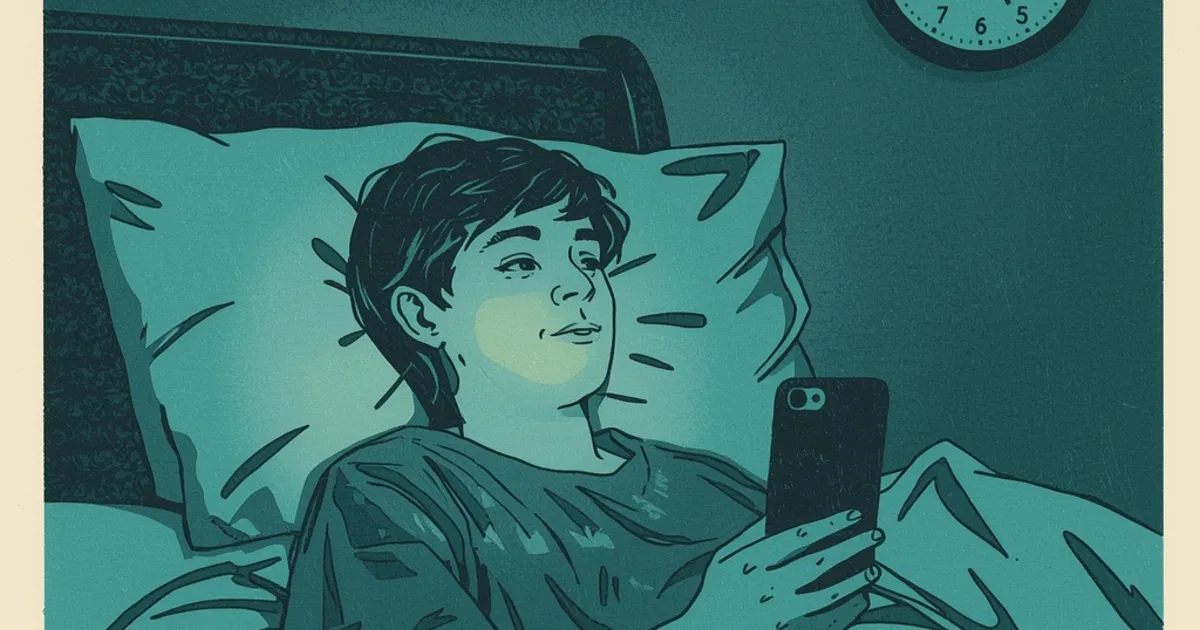
more than 125,000 children and teenagers. Having a phone or tablet in the bedroom at night was
linked to not enough sleep, poorer sleep and more daytime sleepiness. Children who merely had
access to a device at bedtime were affected too, not only those using it. Poor sleep harms
mood, attention and emotional control in anyone. Some of the teenage distress signal may be a
sleep signal.
What parents and schools can do
- Keep phones and tablets out of bedrooms at night. Charge them in the kitchen. This rests on
the strongest evidence in the field.
- Replace the time, don't just remove the phone. Sport, outdoor play and seeing friends in
person are what the teenagers doing well had more of.
- Watch the child, not the clock. Withdrawal, poor sleep and dropping old friends are worth
a conversation whatever the screen time.
- Be wary of anyone certain, either way. The evidence does not yet support "phones are
destroying a generation" or "it's all a moral panic".
Sources
- Carter, B., Rees, P., Hale, L., Bhattacharjee, D., & Paradkar, M. S. (2016). Association between portable screen-based media device access or use and sleep outcomes: A systematic review and meta-analysis. JAMA Pediatrics, 170(12), 1202–1208. jamanetwork.com
- Centers for Disease Control and Prevention. (2023). Youth Risk Behavior Survey data summary & trends report: 2011–2021. cdc.gov/yrbs/dstr
- Haidt, J. (2024). The anxious generation: How the great rewiring of childhood is causing an epidemic of mental illness. Penguin Press.
- Odgers, C. L. (2024). The great rewiring: Is social media really behind an epidemic of teenage mental illness? Nature, 628, 29–30. doi.org/10.1038/d41586-024-00902-2
- Orben, A., & Przybylski, A. K. (2019). The association between adolescent well-being and digital technology use. Nature Human Behaviour, 3, 173–182. doi.org/10.1038/s41562-018-0506-1
- Twenge, J. M., Joiner, T. E., Rogers, M. L., & Martin, G. N. (2018). Increases in depressive symptoms, suicide-related outcomes, and suicide rates among U.S. adolescents after 2010 and links to increased new media screen time. Clinical Psychological Science, 6(1), 3–17. doi.org/10.1177/2167702617723376



.jpg)


