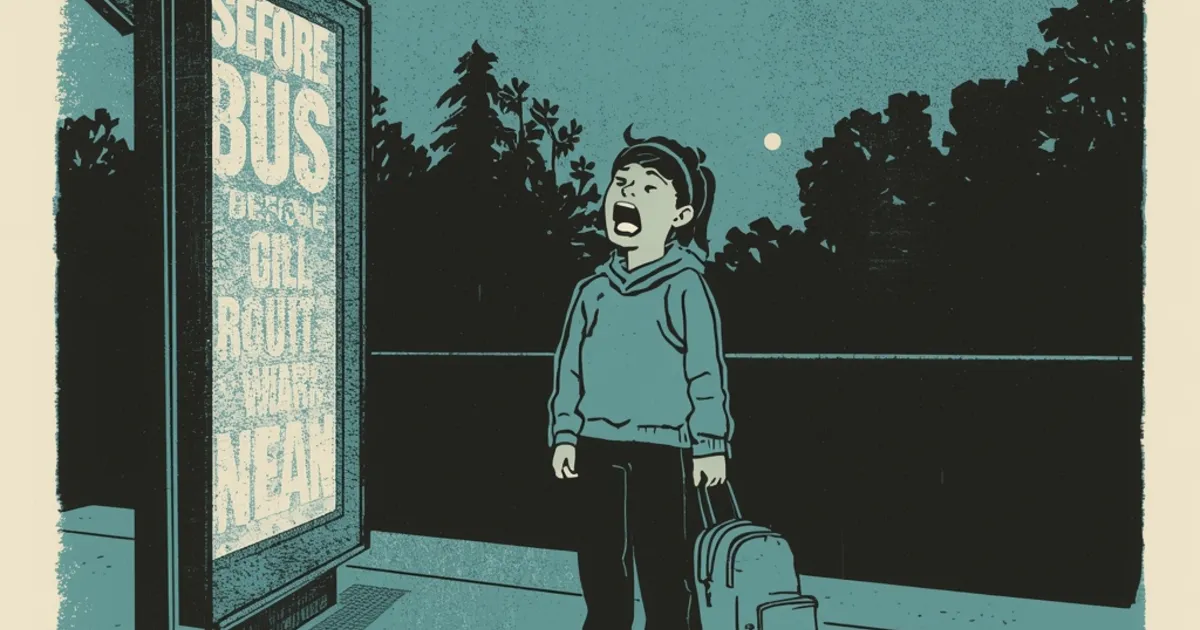
Dave's daughter comes home crying on a Tuesday in May because she got a C on a project about the water cycle. She's seven. She takes the lawnmower apart to see how it works and asks "why" forty times a day. Dave, a concreter from Bunbury, can feel when a mix is off, and something here is off.
Dave and Chloe are a composite, drawn to show the argument. Plenty of parents will recognise them. The evidence below is real, and it starts with the thing that keeps a tired family at the kitchen table every night.
Eight hours against three
In 2012 Italian fifteen-year-olds reported 8.7 hours of homework a week, the most in the OECD. Finnish fifteen-year-olds reported 2.8, the least. Finland scored 519 in maths. Italy scored 485 (OECD, 2013).
Two countries prove nothing, so we ran all 34, using the OECD's own averages for homework hours and maths scores from the same students. There was no relationship at all. One more weekly hour went with 0.75 of a point less on the test, and the margin of error, from 8 points less to 7 more, covers zero. Finland set less than half the homework Australia did and scored 15 points higher.
That doesn't show homework hurts. Homework travels with wealth, curriculum and culture, and these are students' own reports. It shows something narrower and more useful: the idea that more homework makes a higher-scoring country has nothing to stand on here.
Watch what happens when countries change
Comparing countries mixes in everything else about them, so we compared each country with itself nine years earlier. Between 2003 and 2012 the OECD average fell from 5.9 to 4.9 hours a week (OECD, 2013, 2014). Of the 33 economies that cut homework, 16 went up in maths and 17 went down. Poland, Italy and Germany each cut it by an hour and a half or more and gained 10 to 27 points. Of the five that raised it, four lost ground. Australia added a little and fell 20 points, about half a year of schooling.
The data can't show homework cuts scores, and plenty else happened to Australian schools in those years. They do show that more homework didn't buy gains, and that the countries brave enough to cut it did not fall off a cliff.
Where the idea comes from
Harris Cooper's review of more than a hundred homework studies found the link with achievement close to zero in primary school and stronger in high school, where keen students do more of it anyway (Cooper et al., 2006). A correlation can run either way.
So why do we keep doing it? The habit rides on the shape of the school it sits in: age groups, bells, one adult at the front. In 1763 Frederick the Great, with his country wrecked by war and his army bled, ordered children into village schools to make orderly, useful subjects. American reformers later copied it. By 1916 one of them wrote that schools were "factories in which the raw products (children) are to be shaped and fashioned" (Cubberley, 1916, p. 338). Nobody chose this because research on learning recommended it. It was built to run large numbers of children cheaply, and it still does. Dave learned everything he knows by doing it wrong and watching people who could. Chloe gets a C.
What the children are paying
If homework bought learning, the cost might be worth arguing over. In the United States, the share of high-school students reporting weeks of sadness so bad they stopped usual activities held near 26 to 29 per cent from 1999 to 2009. By 2021 it was 42.3 per cent, and 56.6 per cent of girls (Centers for Disease Control and Prevention, 2026). In Australia, serious distress among 15- to 19-year-olds rose from 18.6 per cent in 2012 to 26.6 per cent in 2020 (Mission Australia & Black Dog Institute, 2021).
Phones are part of that story. A school day with more testing and less play may be too. Nobody has separated the two, and children carry both.
What works instead
Finnish children start formal school at seven, get a break every forty-five minutes and little homework (Sahlberg, 2015). Across 32 studies, Montessori classrooms beat traditional ones on school results and on self-control and creativity (Randolph et al., 2023). New Zealand children taught to read at seven caught up with those taught at five by about eleven (Suggate et al., 2013). These aren't theories. They're running now, with real children.
What you can do
You don't need permission to ask a question. Email your child's school this week: "What evidence says homework helps at this age, and what does the school's policy say?" Most teachers already know the answer, and some will be relieved you asked. In primary school you can say, politely, that your child is reading with you tonight, and that's the homework. Then give the kid an hour with something they want to take apart.
The only reason we keep doing it this way is that we have always done it this way. A seven-year-old crying over a water cycle should be enough.
Sources
Centers for Disease Control and Prevention. (2026). Youth Risk Behavior Surveillance System (YRBSS): High school national estimates and Mental health indicators [Data set]. https://data.cdc.gov/
Cooper, H., Robinson, J. C., & Patall, E. A. (2006). Does homework improve academic achievement? A synthesis of research, 1987–2003. Review of Educational Research, 76(1), 1–62. https://doi.org/10.3102/00346543076001001
Cubberley, E. P. (1916). Public school administration. Houghton Mifflin.
Mission Australia, & Black Dog Institute. (2021). Psychological distress in young people in Australia: Fifth biennial youth mental health report, 2012–2020. Mission Australia.
OECD. (2013). PISA 2012 results: What makes schools successful? (Volume IV). OECD Publishing. https://doi.org/10.1787/9789264201156-en
OECD. (2014). Does homework perpetuate inequities in education? PISA in Focus, (46). https://doi.org/10.1787/5jxrhqhtx2xt-en
Randolph, J. J., Bryson, A., Menon, L., Henderson, D. K., Kureethara Manuel, A., Michaels, S., Rosenstein, D. L. W., McPherson, W., O'Grady, R., & Lillard, A. S. (2023). Montessori education's impact on academic and nonacademic outcomes: A systematic review. Campbell Systematic Reviews, 19(3), e1330. https://doi.org/10.1002/cl2.1330
Sahlberg, P. (2015). Finnish lessons 2.0 (2nd ed.). Teachers College Press.
Suggate, S. P., Schaughency, E. A., & Reese, E. (2013). Children learning to read later catch up to children reading earlier. Early Childhood Research Quarterly, 28(1), 33–48. https://doi.org/10.1016/j.ecresq.2012.04.004