Yes. A 2015 systematic review found risky outdoor play linked to more physical
activity and better social health, with no clear rise in injuries. Children who climb, race and
wrestle learn to judge danger. Children kept from it never get the practice.
What counts as risky play
Ellen Sandseter, a Norwegian early childhood researcher, watched preschoolers play outdoors
and sorted the thrilling, slightly scary kind of play into six types:
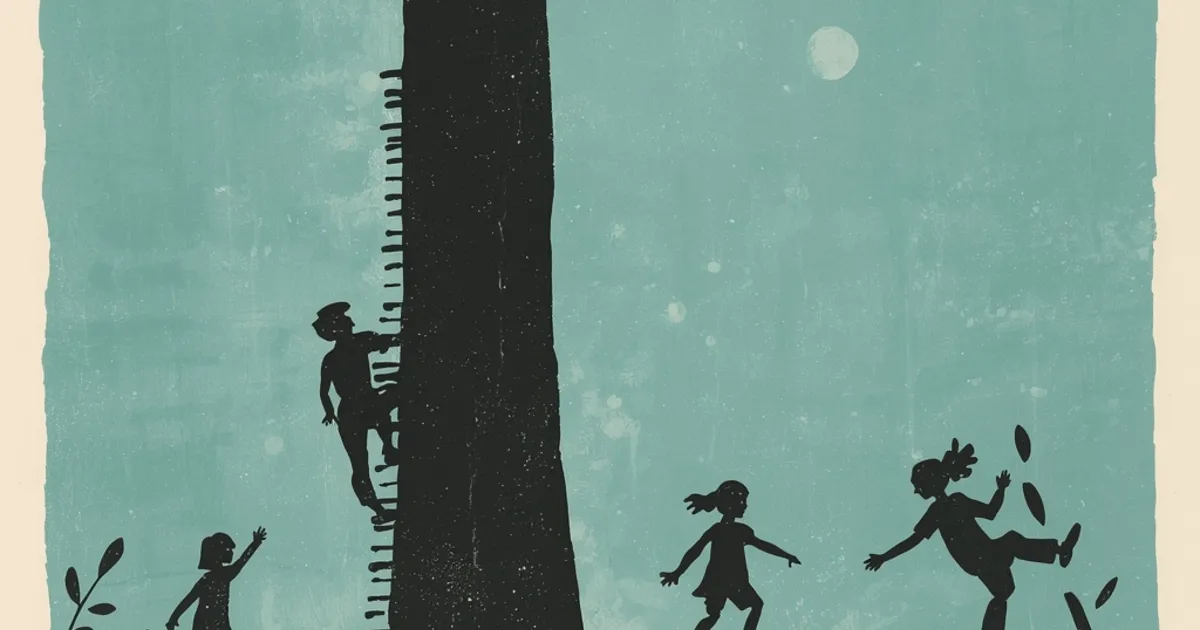
- Great heights: climbing trees and rocks, jumping off things, balancing up high.
- High speed: fast swings, slides, running, bikes, sleds.
- Harmful tools: saws, hammers, knives, rope.
- Dangerous elements: water, fire, cliffs, deep snow.
- Rough-and-tumble: wrestling, chasing, play fighting.
- Disappearing: exploring alone, hiding, going out of adult sight.
Most parents recognise the list from their own childhood. Most will also recognise it as the
list playground rules, school policies and nervous adults work hardest to remove.
What the evidence shows
In 2015 Mariana Brussoni and a team of fourteen researchers reviewed 21 studies of risky
outdoor play and child health. Overall, the effects were positive. Children with chances for
risky play moved more and showed better social health and behaviour, with less aggression.
Injuries did not climb the way adults expect. The authors recommend promoting risky outdoor
play.
The review graded much of the evidence as low quality, as most play research is: you
cannot randomly assign children to grow up with or without tree climbing. But every study
pointed the same way, and none showed the harm people fear.
Why a little fear helps
Sandseter and psychologist Leif Kennair proposed a reason in 2011. Risky play gives children
a rush of excitement while exposing them to things they once feared: heights, speed, deep
water. As skill grows, the fear shrinks. Psychologists use the same step-by-step exposure to
treat phobias. Risky play looks like children running that treatment on themselves.
A child who has fallen off a low wall knows how a fall feels and how high is too high. A
child who has never been allowed up the wall meets the first real drop with no practice. The
anti-phobic idea is still a theory, but it fits what the review found: children allowed to take
risks are not injured more.
Free play has shrunk
Psychologist Peter Gray, writing in the American Journal of Play in 2011, gathered
evidence that children's free play with other children has fallen sharply in the United States
and other rich countries over half a century. Over the same years, anxiety, depression and
feelings of helplessness in young people rose. Gray argues the two are linked, because free
play is where children learn to solve problems, control themselves, manage fear and make
friends as equals. The link is a correlation, not proof, and Gray says so. Other forces,
including phones and money stress, play a part.
In Australia, Helen Little and Shirley Wyver examined how tightening rules in early
childhood services shape outdoor play. Their 2008 paper argues that avoiding every risk also
removes the benefits: the chance to learn new skills, try new behaviour and find out what
the body can do.
Recess helps in the classroom too
Play is not time stolen from learning. A 2009 study in Pediatrics of more than 10,000
American eight- and nine-year-olds found 30 per cent had little or no daily recess. Classes
with at least 15 minutes of recess a day got better behaviour ratings from teachers.
Anthony Pellegrini and Catherine Bohn reviewed the experimental evidence in 2005 and found
breaks help children pay attention when they return to class.
We knew this in 1943
In the 1930s the Danish landscape architect Carl Theodor Sørensen noticed children ignored his
tidy playgrounds and played in building sites and scrap heaps. In 1943 a housing association in
Emdrup, near Copenhagen, opened a "junk playground": scrap timber, tools, earth and a trained
adult who stayed out of the way. Marjory Allen, Lady Allen of Hurtwood, visited in 1946 and
brought the idea to Britain's bomb sites as the "adventure playground". Some still run
today.
What you can do
- Let children climb as high as they can get themselves. If they cannot climb up alone, they
are not ready to be up there.
- Swap "be careful" for something useful: "Where will you put your foot next?"
- Allow play fighting. Children learn to read signals and hold back their strength.
- Give them loose parts: planks, crates, rope, water, dirt.
- Ask your school how long recess runs, and whether it is ever taken away as punishment.
- Look for an adventure playground or nature play space near you.
The aim is not to remove danger. It is to keep risks small enough to survive and real
enough to learn from.
Sources
- Barros, R. M., Silver, E. J., & Stein, R. E. K. (2009). School recess and group classroom behavior. Pediatrics, 123(2), 431–436. publications.aap.org
- Brussoni, M., Gibbons, R., Gray, C., Ishikawa, T., Sandseter, E. B. H., Bienenstock, A., … Tremblay, M. S. (2015). What is the relationship between risky outdoor play and health in children? A systematic review. International Journal of Environmental Research and Public Health, 12(6), 6423–6454. doi.org/10.3390/ijerph120606423
- Gray, P. (2011). The decline of play and the rise of psychopathology in children and adolescents. American Journal of Play, 3(4), 443–463. eric.ed.gov/?id=EJ985541
- Little, H., & Wyver, S. (2008). Outdoor play: Does avoiding the risks reduce the benefits? Australian Journal of Early Childhood, 33(2), 33–40. doi.org/10.1177/183693910803300206
- Pellegrini, A. D., & Bohn, C. M. (2005). The role of recess in children's cognitive performance and school adjustment. Educational Researcher, 34(1), 13–19. doi.org/10.3102/0013189X034001013
- Sandseter, E. B. H. (2007). Categorising risky play: How can we identify risk-taking in children's play? European Early Childhood Education Research Journal, 15(2), 237–252. doi.org/10.1080/13502930701321733
- Sandseter, E. B. H., & Kennair, L. E. O. (2011). Children's risky play from an evolutionary perspective: The anti-phobic effects of thrilling experiences. Evolutionary Psychology, 9(2), 257–284. doi.org/10.1177/147470491100900212
- Emdrup Junk Playground and Lady Allen of Hurtwood's 1946 visit: Kozlovsky, R. (2008). Adventure playgrounds and postwar reconstruction. In M. Gutman & N. de Coninck-Smith (Eds.), Designing modern childhoods. Rutgers University Press, 171–192.

a.jpg)


